Rare Sci-Fi from 1930s Germany

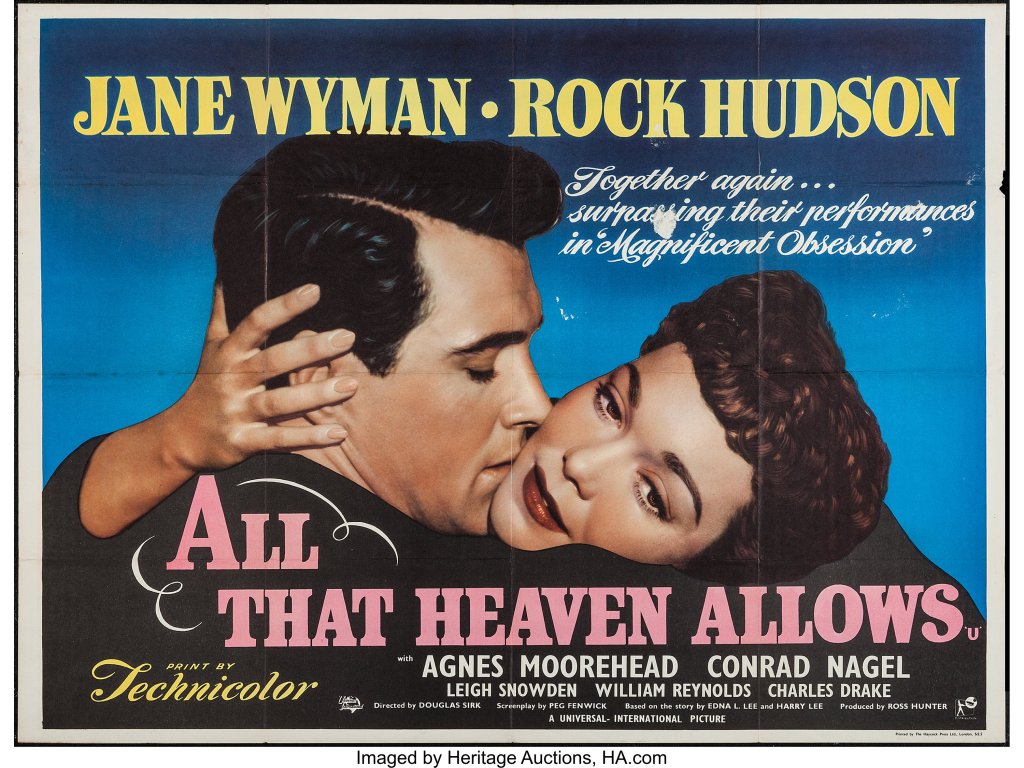
Gold (1934), directed by Karl Hartl. Movie night on Blu-ray on Monday, January 2.

This bizarre, Nazi-era science fiction film is about a man who invents a machine that can turn lead into gold, whose partner (the actual brains behind the machine) is murdered by a wealthy Scot. That Scot kidnaps our hero (Hans Albers, whose popularity was such that the Nazis allowed him to continue working despite his Jewish wife) and then the hero plots to destroy the machine.

This was a fun, exciting, and bizarre movie, whose massive sets look, at the very least, inspired by Metropolis and maybe even were the reused sets from that famous silent film. Brigitte Helm, the robot in Metropolis, even has a large role here. There’s a lot of stuff about gold and its effect on the economy, which I’m sure was Nazi propaganda somehow (though aimed at the Scots?) and yet, according to most sources I’ve found, Albers wouldn’t work on a picture that pushed the National Socialists’ agenda.

After watching Colonel Blimp recently, I am struck by how winning wars changes opinions. I mean, the British have done a swell job of committing unbelievable atrocities and then getting away with presenting themselves as heroes–I mean, not just Colonel Blimp, but Zulu and The Man Who Would Be King are all movies in service to cheering on England’s bloody crimes in Africa and Afghanistan. And here, with Gold and other movies (most now available on DVD from Kino), we see movie, and other films, made by people caught in Germany who are understandably poisoned by their making art in such a climate. Fascinating.

Kubrick on the Border

Hit the Road (2022), directed by Panah Panahi. Streaming at home on Sunday, January 1.

This subtle story of an Iranian family’s long road trip to deliver a fugitive son across a northern border is a beautiful, heartbreaking and ultimately frustrating movie. I’m glad I saw it and wished I liked it more. There are four people, a family, in the car: Mom (Pantea Panahiha), Dad (Mohammad Hassan Madjooni), the Kid (Rayan Sarlak), who screams throughout the picture, and the older son (Amin Simiar) whose need to get out of the country literally and figuratively drives this movie.

Continue reading

The Happiness Factor: My Top Ten (Actually Seventeen, really Eighteen) Favorite Movie Moments

The Sight & Sound list of the Greatest Films of All-Time list dropped just a few weeks back, and, as usual, it is both a magnificent and awful thing. Magnificent because it undoubtedly sells a lot of copies Sight & Sound and keeps people’s tongues wagging about that august film journal from Britain. I love Sight & Sound–I think it’s beautifully designed, well written, and damned fun to read, so anything that keeps it in print is a positive, in my mind. Also, it’s magnificent because, unlike, say, the Modern Library’s 100 greatest novels of the 20th Century (from around 2000), decided upon by a star chamber of critics and writers who bestowed the list upon us unworthies, the Sight & Sound list comes to us from literally hundreds of academics, writers and filmmakers, so it’s unusually democratic. And S&S keeps expanding it with every decade’s vote, bringing in people from around the world. I think the vote exceeds 1,500 people. That’s awesome.

Continue reading

Gritty 70s Oscar Bait

Klute (1971), directed by Alan J. Pakula. Trylon Cinema’s 16mm paranoia show on Wednesday, December 28.

Klute fits firmly into the category of movies that people I respect love and I absolutely can’t stand. In fact, I remain stunned that they can’t see its myriad flaws. Its plot is utterly ridiculous: an upstanding man from a small Pennsylvania town is missing in New York City. The police come to his house and show his wife filthy typed letters he supposedly wrote to a prostitute named Bree (Jane Fonda). The family hires the man’s best friend and local cop Klute (Donald Sutherland) to investigate. Klute is paid to do this by the vanished man’s partner, Peter (Charles Cioffi). This Peter, from minute one, is the only one who could possibly be responsible for the disappeared man’s death, and we know he’s the culprit because this threadbare plot can’t conjure up enough complications to make us think otherwise.

Continue reading

Take Your Time, Lubitsch!

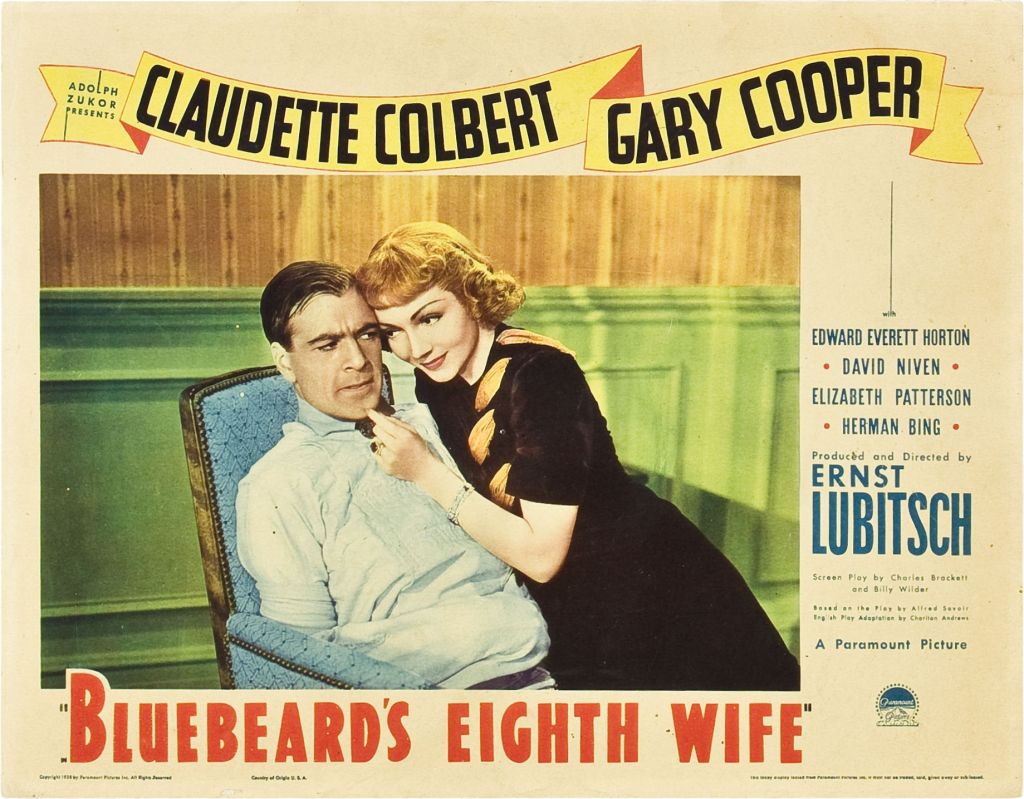
Bluebeard’s Eighth Wife (1938), directed by Ernst Lubitsch. Criterion Channel at home on Monday, December 26.

Christ almighty, I have never seen so many funny moments in such a confused, sloppy mess as Bluebeard’s Eighth Wife. Imagine all of the great screwball comedies–seriously, pick any one, from Bringing Up Baby to His Girl Friday to Ninotchka–and then boil down their plot, character and any themes, remove any emotion, cut out most transitionary moments, leaving behind a thick sauce of jokes, and that’s Bluebeard. It’s the story of a guy, Michael Brandon (Gary Cooper), who is rich and has been married seven times, who runs into Nicole de Loiselle (Claudette Colbert), a woman who doesn’t have much money and is the daughter of a friendly, scheming father. Their meeting is charming: we wants to buy only the tops of a pair of pajamas, the store won’t let him, so Nicole steps in and says she only wants the lower half. It’s a long scene, timed perfectly, funny, a bit touching, establishing Michael and Niocole as two potential lovers we want to spend time with.

That’s the only time we’re going to linger over any moment in this movie. In rapid-fire fashion, Michael woos her, she hates him, then falls for him, discovers he had seven wives prior, she is upset but turns the tables on Brandon by agreeing to marry him if he guarantees her $100,000 a year salary if they divorce. So they marry and a battle of wills ensures.

Sounds great, yeah? It’s hilarious, but the jokes are empty because screenwriters Billy Wilder and Charles Brackett, along with Lubitsch, develop nothing. Seriously, after that initial pajama-buying scene, the story just absolutely races from one set piece to the next: one minute Brandon and Nicole hate one another, the next minute she declares her undying love for him. It’s so abrupt we both wondered whether or not this was an edited version. It’s not. Naturally, there’s a big gag at the climax of the movie that is just so well crafted but utterly toothless because we’ve been whipping between love and hate without much development of the relationship. There’s supporting characters played by Elizabeth Patterson, Edward Everett Horton and David Niven that are also funny but appear and disappear so swiftly we barely get to know them. It’s as if Lubitsch thought that there was no way this movie would be good at 100 minutes, so he sliced anything that wasn’t bonkers comedy from the film.

It’s like the potato chip party I had years ago: 20 bags of chips from around the world, and after a very short while you were gasping for water and anything that wasn’t coated with salt. Empty calories, this, but a pleasant diversion if you need to kill 80+ minutes.

Gary Cooper missed the boat on screwball comedy, though. The dude was funny. Too bad he took the “high” road and stuck with westerns and dramas. His loss.

Bewitched, Bothered and Bewildered: The Archers’ Propaganda Machine

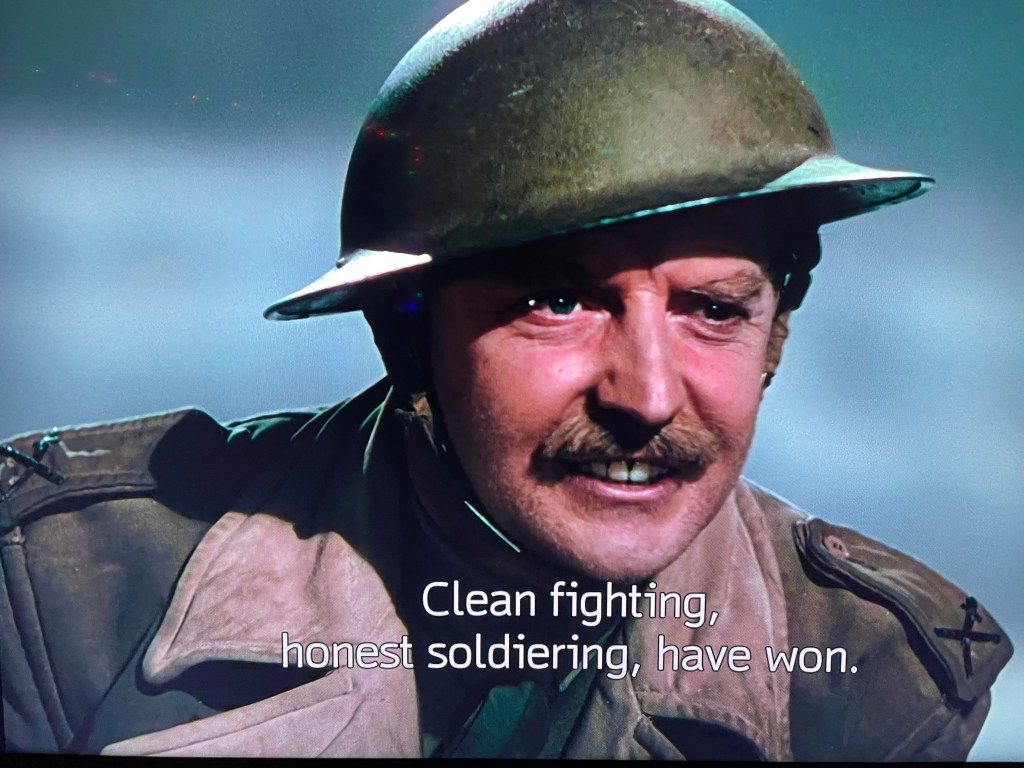
The Life and Death of Colonel Blimp (1943), directed by Michael Powell and Emeric Pressburger, Criterion Channel at home on Xmas Eve.

Honestly, I love it when a movie moves me terribly and confuses me proper. When it comes to The Life and Death of Colonel Blimp, perhaps it’s best to consider these two very different critics:

In the film, Blimp is honorable, kindly, decent, but helplessly old-fashioned. In truth, he probably believed in capital punishment, keeping the wogs in their place, flogging homosexuals, and a little charity for the poor. –David Thomson, Have You Seen…? A Personal Introduction to 1,000 Films

This is a film about loss and longing, about creating the impossible and then setting it beyond your grasp. This is a film about home and the meaning of home, the meaning of self. This is a film which lies in the most human ways but tells remarkable, human truths… [it] is more poignant and savagely forgiving, more melancholy, troubling and revealing, than almost any other cinematic work I have encountered. –A. L. Kennedy, BFI Film Classics: The Life and Death of Colonel Blimp

That first quote is from a cranky old white man whose opinions I admire but sometimes recoil from; the second is a white female novelist who considers herself a pacifist and, in life, would loathe Blimps (by her own admission).

Continue reading

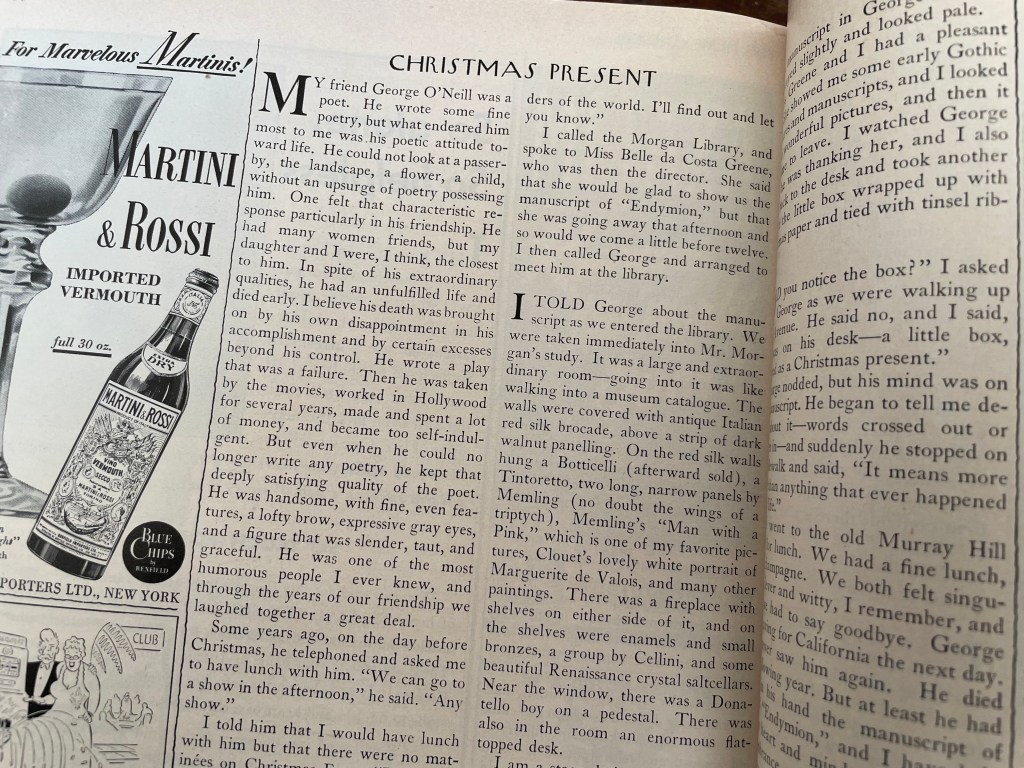
“Christmas Present” by A. B.

We take a break from our regularly scheduled programme to bring you this special holiday message:

I have recently purchased a library-bound November and December 1951 New Yarker, and have been treasuring its strange advertisements and, frankly, overlong stories for the past few weeks. Because the articles haven’t been all that great, I was stunned to come upon Aline Bernstein‘s reminiscence, “Christmas Present”, in the December 22 issue. This short, slight, paradoxically heartwarming and heartbreaking memory floored me as I read it over coffee. It celebrates all that I love about the season: friendship, curiosity, the pleasure of afternoon excursions, art and its mysteries, of feeling “singularly clever and witty” with another person over lunch, all of this wrapped up in a lovely little package.

Aline Bernstein was a celebrated set and costume designer in the first half of the 20th Century. As she notes, her friend George O’Neill (it’s actually O’Neil, one ‘l’, and I’m not sure why she added the second), was known, perhaps, for the scripts to the American remake of Intermezzo and the first Magnificent Obsession (the remake, by Douglas Sirk, is better known). He died in obscurity–I can’t even find an obituary.

I’ve re-typed this story for everyone to enjoy, because our friends at the New Yarker don’t make their archives available unless you shell out for a subscription, which seems to go against what the holiday season means to me. Maybe they’ll demand I take it down eventually. I hope you enjoy it for a little while anyway. I’m going to read “Endymion” today, though I doubt I’ll understand it. I will also give thought to what object I would seek out that would give me as much profound joy as that manuscript gave George.

Happy holidays to all my family, friends, and those I have encountered with joy.

Continue reading

Cluny Brown is Love

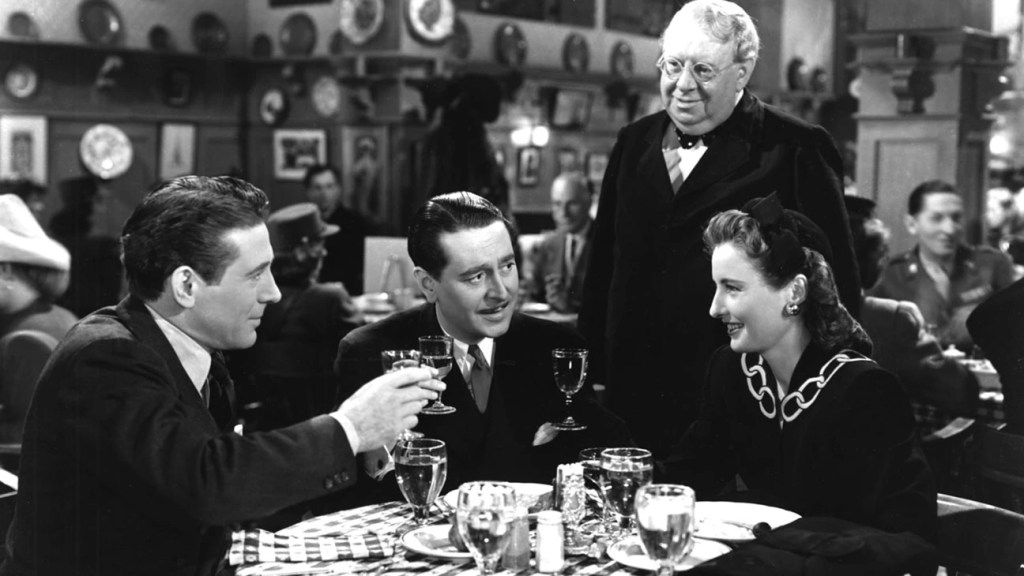
Cluny Brown (1946), dir. Ernst Lubitsch. Blu-ray at home, Friday, December 16.

Whenever there’s talk about favorite movies, my assumption is that the people who discuss “the greatest” mean movies that they’ve been watching, enjoying, or have been influenced by for many years. Pictures they’ve seen again and again. To stretch a point, these films are like a good couple finally getting married: when two people have been in love for some time, and you admire their coupledom, it’s exciting to hear about the forthcoming nuptials and you hope for a wedding invitation (or, at least, I do–I love weddings).

But what about that couple that’s fallen madly, brazenly in love, a swift, passionate romance, bam, Bam, BAM! and they’re getting married. Oh, man, what? You two got married already? How long have you known each other? I mean, yeah, it’s great, but… No matter the age of the lovebirds, we tend to think of the words “reckless” and “rash” and, worse, perhaps, “unwise”, “foolish”, etc. No one should get married that quick.

Well, that’s me and Cluny Brown. I love this ridiculous, flawed movie, I’ve bugged people about it, I watch it again and again and again and would put it on my top ten list for no other reason than “you know what, go to hell, I love this movie!” I first saw it three years ago and I wrap my arm in Cluny’s arm and announce that it’s one of my favorites of all-time. Don’t judge me.

Continue reading