The Tall T (1957), directed by Budd Boetticher. DVD at home with Aunt Betsy, Thursday, March 23.
I think one definitely sign of my being out of touch is that I like Westerns. When I work at places with a lot of young people, at some point I’ll mention I like Westerns, or John Wayne, or I’ll be seen reading a Western novel, some classic like Butcher’s Crossing or The Searchers. The very few times Westerns have screened at either the Heights or Trylon, they’ve flopped, and I mean big-time. Enough to keep those places from ever showing them again (though I give the Trylon credit for screening a bunch of Peckinpah Westerns soon, though I bet they’ll also do poorly).
Bachelor Mother (1939), dir. Garson Kanin. Streaming at home with my Aunt Betsy, Sunday, March 19.
It’s funny how a movie sneaks up on you: I’d seen Bachelor Mother before, at the Heights in 2019, and enjoyed it and then forgot about it. When I watched last holiday season, I couldn’t remember if I’d seen it before, but was pretty sure I had. And that time, last Christmas, I thought it was astounding, bought the DVD, and now plan to watch it every holiday. So, naturally, when my dear Aunt Betsy came to visit a few weeks ago, we wanted something light and fun, out came Bachelor Mother. And it’s true–we all came to the conclusion that this movie could also be called Men Are Idiots. That would actually make a great series as well.
The Heartbreak Kid (1972), directed by Elaine May. Trylon microcinema volunteer night, Wednesday, March 15.
Lucky me, I was invited to a super secret 16mm screening of Elaine May’s impossible-to-find masterpiece, The Heartbreak Kid. It’s super secret because the aspirin people, Bristol-Myers, produced movies in the 1970s through a company called Palomar (a lot of corporations were doing this back then.) Palomar eventually folded, and, for whatever reason, this movie’s rights are still held by Bristol-Myers-Squibb (as they’re now called). Why? A lot of the Palomar movies are available (most notably, perhaps, The Taking of Pelham 123), and you wouldn’t think this pharmaceutical company would care. But I guess they do, because you can’t see this damn thing anywhere. You can’t get the rights, you can’t screen it, and I guess everyone’s afraid of lawsuits. Which makes sense.
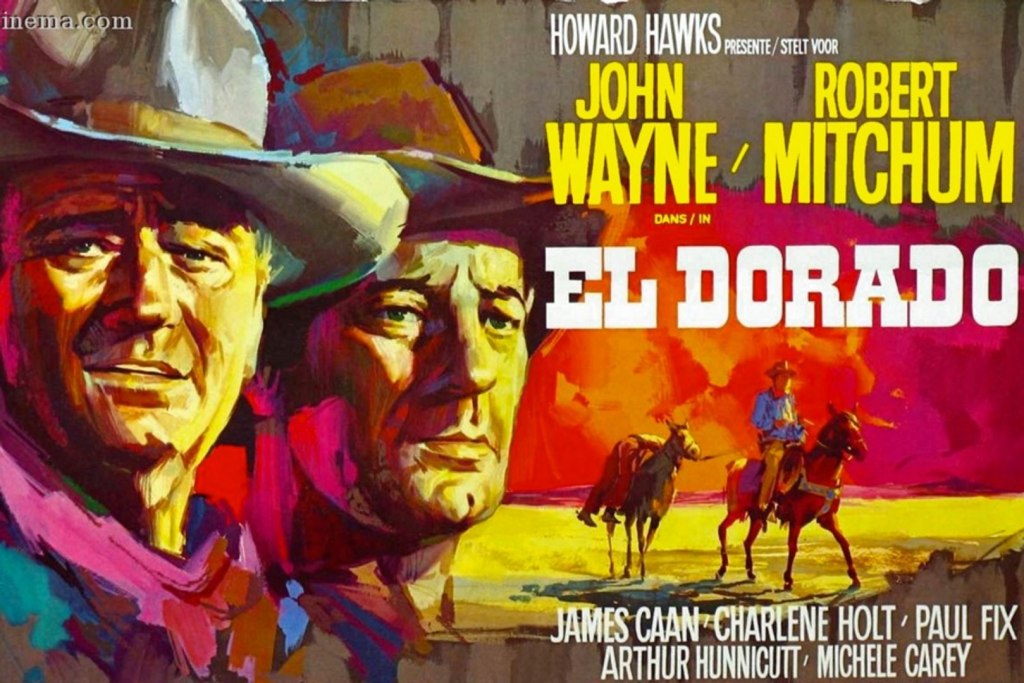
El Dorado(1966), directed by Howard Hawks. Tuesday, March 14, streaming at home.
El Dorado, not to be confused with the awful Dreamworks cartoon of 2000, is basically a remake of Rio Bravo, another Howard Hawks western with a bunch of pals sittin’ around and yakking and trying to make the world a better place by putting away the bad guys. John Wayne’s Cole and Robert Mitchum’s J.P. used to go around committing hijinks and making friends with beautiful ladies on tight-fitting corsets before settling down. J.P. becomes a drunk and can’t do his job, so Cole comes to town to help. Along the way they meet a dude named Mississippi (James Caan).There’s other characters, too.
Hawks’ great mantra was “three great scenes and no bad ones”, and that sums up El Dorado. This movie is fun as hell, expertly played, three terrific scenes, including a gunfight in a church belfry where the bullets keep striking the bells, making them sing. It’s hilarious, some of the dialogue and retorts strange and amusing–pieces of this film feel like it’s very modern (sadly, others make it terribly dated). Mitchum is great in whatever he does, but Wayne had a great benefactor in Howard Hawks. Wayne’s Cole is a graceful, muscular force that you’ll happily follow through the 2+ hours of this movie. El Dorado was a product, but a really good one, a fun machine that celebrates genuine people and what they can do, and we don’t have enough of that today. If I had to make a top ten list, it might not have a Howard Hawks movie on it. But if I made a top 100, there’d be more by him than any other director.
Es geschah am hellichten Tag (It Happened in Broad Daylight) (1958), directed by Ladislao Vajda. Monday, March 13, Blu-ray from Europe at movie night.
A long time ago, I found one of those 500 Movies to Watch Before You Die-type books at an estate sale, this particular one being assembled by Time Out in London, or some other UK publisher. Sometimes these books have interesting essays, though usually not. Not due to any great accomplishment on my part, I have never encountered one where I hadn’t at least heard of the movie (there were many I hadn’t seen).
Until this one. Buried deep in the middle of this list was the weird Swiss/German production of It Happened in Broad Daylight, from 1958. The story of a detective chasing down a child killer sounded much like Fritz Lang’s M, and, since I hadn’t heard of it, made me want to watch it badly.
A Room with a View (1985), directed by James Ivory. Sunday, March 12, Criterion Channel at home.
I don’t really know what made us watch A Room with a View last night, except that is was featured on the Criterion Channel and I remember kind-of liking it when it came out. Over the years, though, I came to dislike their films–the Merchant-Ivory movies of the 80s and 90s became a brand name for dull, usually English art-house fare, the stuff that clogged little cinemas and kept genuinely interesting films from those screens. That’s annoying and should’ve kept me from ever watching their flicks again. But watch it we did and we were moderately entertained.
Mr. Arkadin (The Corinth Version) (1955), directed by Orson Welles. Saturday, March 11, Criterion Channel at home.
I guess I never really noticed how Mr. Arkadin, yet another butchered film from Orson Welles, is so similar to Citizen Kane. A secretive industrialist, Gregory Arkadin (Welles), hires the greedy, will-do-nearly-anything-for-a-buck Guy Van Stratten (a very strange Robert Arden) to investigate his (Arkadin’s) life. Arkadin claims he doesn’t know how he became rich, that he just woke up one day in Switzerland with a bunch of money, which he used to become fabulously wealthy. Van Stratten goes all over the world to interview past associates, with sinister results. As with most of Welles’ laster films, this one has weird dubbing, incredible camerawork, a bizarre and over-the-top performance by Welles (which I enjoy tremendously–I like that stagey, ham acting when it’s done right), strange costumes, and it seems to be about the life of Welles himself. Like Kane, which is both about the ludicrously rich Hearst and Orson Welles himself, Arkadin is about, again, another terrible human being with a lot of money (supposedly based on some financier who screwed Welles over when making another film, I think Othello), but is also very much about Welles. Who am I? he seems to be asking in this weird little noir, as if pointing out that he, too, just appeared, rich with ideas, when he was 25, in Hollywood, and made this amazing film called Citizen Kane.
We Make Music (Wir machen Musik) (1942), directed by Helmut Käutner. Monday, March 6, movie night.
Apparently, there was someone named Ilse Werner, pictured above, who was known as the “whistling star”. She whistled, and quite a bit, in this strange little musical We Make Music, crafted as a diversion to the Germans during World War II. It’s pure escapism, a silly plot and jazzy music, two leads with decent chemistry, some impressive camerawork. Voila! A fun distraction from the war. But Ilse Werner is fascinating, aside from her whistling (which I admit is pretty amazing, if limited in interest), she’s got such magnetism you can’t take your eyes off of her, and think of her whenever she’s not in the film. Her work was banned by the Allies after the war for participating in propaganda, one can only wonder what she would’ve done had she moved to America.
A Brighter Summer Day (1991), directed by Edward Yang. Sunday, March 5, Trylon Cinema.
My god, A Brighter Summer Day was incredible. This four-hour (!) epic I’ve heard compared to The Godfather, but it’s nothing like that at all, at the very least in being honest, in being critical of masculine violence (rather than celebrating it), in having actually decent roles for women. It’s as if a filmmaker, Edward Yang, somehow captured all of Taiwan in the very early 1960s, captured every emotion of the displaced Chinese fleeing Mao, of the way the teenagers rebelled and devoured American popular music. I can barely wrap my brain around it, I was so stunned and trying to hard to grasp everything. It’s about teenage gangs, there’s a murder, there’s interrogation of innocent people, there’s humor… there’s life, an entire world, in its four hours. I’m going to try to watch it again soon on Criterion in the hopes of digesting more of its utter majesty.
The Bad and the Beautiful (1952), Friday, March 3, and Two Weeks in Another Town (1962), Saturday, March 4, both directed by Vincente Minnelli, both streaming at home.
I like 1950s and 60s melodrama, the turgid emotions, the confidence meeting hysteria, the over-the-top acting and, in the case of Minnelli and Sirk, the brilliant camerawork that elevates all of this ridiculous storytelling to a fever pitch.







 Movies with People Watching Movies