The Lavender Hill Mob (1951), directed by Charles Crichton. Streaming at home, Saturday, May 13.
Here’s the thing: we hadn’t seen The Lavender Hill Mob in years and decided to watch it the other night. It’s fun–dry humor, witty, the story of well-meaning half-losers or outright losers, two men stuck in bland jobs working with two friendly villains in a silly heist. You know no one’s going to die or even get hurt and no one will get away with anything but, still, prison ain’t so bad in the Queen’s country. These fools are hoping to take millions of pounds of gold and turn it into Eiffel Tower statues and move the stuff in Europe. Meticulously planned by Henry Holland (Alec Guinness), paired with trinket maker Al Pendlebury (Stanley Holloway), the story unfolds and it charms, and it makes you laugh. Audrey Hepburn is in it for just a second. It works, it’s fun, you watch it, the night’s over.
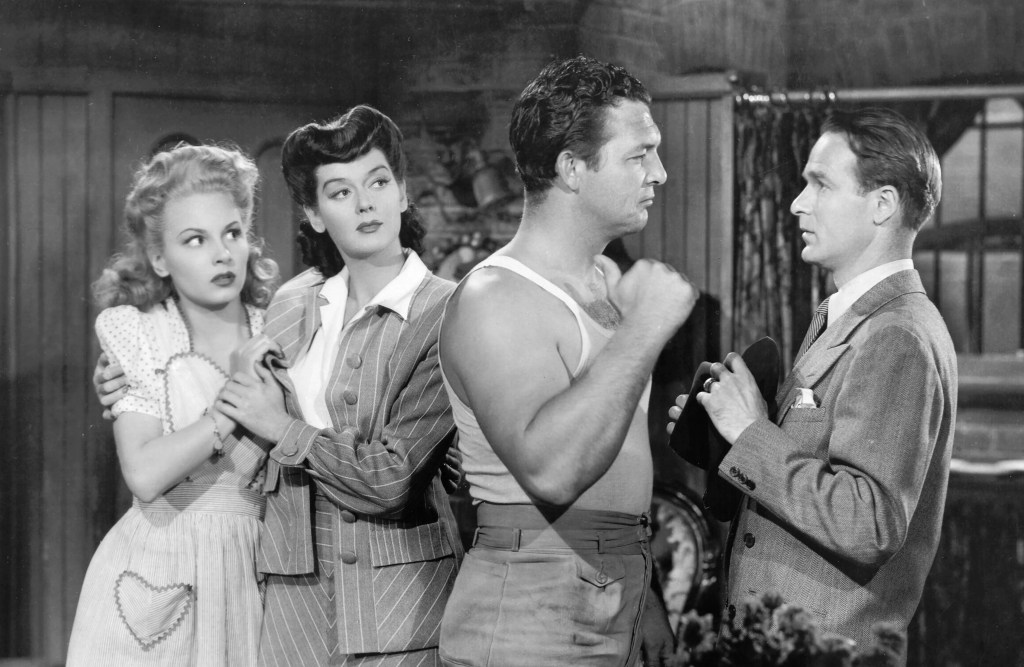
My Sister Eileen (1942), directed by some hack named Alexander Hall. YouTube at home, Friday, May 12.
I guess I saw a Facebook post about a Film Forum series which is centered around movies that portray New York City. One of these was the original My Sister Eileen, from 1942 (there’s a musical remake from the 50s). This flick was never on DVD, not even one from Europe for sale on eBay, and not streaming except in a horribly pixilated version on the Tube of You. But I watched it because Rosalind Russell made some good comedies.
A Fish Called Wanda (1988), directed by Charles Crichton. Streaming at home, Wednesday, May 10.
We were sitting around looking for something to watch, something fun, and I remembered A Fish Called Wanda, a movie I think I saw twice back in Mt. Pleasant in the summer of 1988. I hadn’t yet moved to East Lansing to go to Michigan State University, and so was still stuck in my hometown, digging all of the movies that played there. This one screened at the Cinema Four. There were some particularly stupid films released that summer, among them Rambo III and Crocodile Dundee II and Poltergeist III and Short Circuit 2, not to mention Cocktail, to go along with stuff like Big and Bull Durham, which were surprises, though I doubt they hold up well. Then, in July, seemingly out of nowhere, came A Fish Called Wanda. It was a big hit.
A Night in May (Eine Nacht im Mai) (1938), directed by Georg Jacoby. Movie night at Tom’s, Monday, May 8.
It’s fascinating to watch these so-called “lost” German movies, lost, of course, because they were made by Germans when the Nazis were in power and so no one wants to watch them today. Understandably. But A Night in May is a terrifically charming little film that reminds me of early Ernst Lubitsch–before he infused his movies with intense emotions–and the scenes of small towns in that country are interesting. There’s some truly effective performances, the wonderfully silly plot involving reckless driving and an escape on a bus to an outrageous festival with sausage and beer, there’s some great sexual tension, a big storm, chases on foot and automobile, the works. This flick entertained Germans in 1938, the year of Kristallnacht, and I don’t think people should watch a movie like and not keep that in their minds. In Europe they’re more interested in these movies, and the F. W. Murnau institute keeps these films on hand and screens them there–I also don’t think it’s stating an allegiance to Nazi ideology to be curious about what art people were making in Germany when they were in power (propaganda aside). In America, you couldn’t show these movies, and I don’t know that that’s wrong, and, morality aside (such as that is) it’s also not really commercially viable, since no one has heard of any of the actors, and to market these films, you have to hang your hat on something. Whenever I watch films, I can’t help but wonder how you would screen films for people in a theater, and how you would get the word out, and frankly, I can’t see this ever happening here. One argument I’ve heard in favor of screening these movies (again, from a moral perspective) that the Allied powers committed atrocities, too. I see this played out in one of my favorite movies, The Life and Death of Colonel Blimp, which was made to rouse the British during the big war. Sadly, one of the ways it does that is by celebrating colonialism and, at one point, literally arguing that they, the Brits, did not commit atrocities in the Boer War, which they totally did, and in abundance (uh, they did it in World War II, as well… and every other conflict they were involved in). Thing is, showing Blimp today wouldn’t rouse gangs of pro-colonial or pro-Boer war idiots, while neo-Nazis in America might, in fact, find any movie made under the Führer to be a nice rallying cry. I can watch these movies privately, but hell if it’s a good idea to watch them publicly and give freaks their day in a theater. They probably wouldn’t even appreciate the film for what it is.
Back in the 1950s, at the dawn of television, there were dramatic programs like Playhouse 90 or The Philco Television Playhouse or United States Steel Hour, often pretentious dramas sponsored by major corporations. No one could quite figure out what to do with TV, so they’d have these live productions, like theater, dealing with important issues of the time, a way for big companies to get the word out about their product–like steel?–and elevate the masses with great drama. And, strangely enough by today’s standards, some of these productions were adapted into movies.
Romance in a Minor Key (Romanze in Moll) (1943), directed by Helmut Käutner. Movie night at Tom’s, Monday, April 24.
Helmut Käutner was a German director who worked before, during and after the Nazi era, becoming widely regarded as one of the best directors from that country. I’ve seen a few Nazi-era films, and none of them holds up, nor are as emotionally complex as his works (that I’ve seen, of course). Most movies of this era subtly and not-so-subtly hold up Nazi ideals like love of folklore or dedication to country and family, weirdly enough, many of the same ideals that American films of the time also celebrate. Of course, much of this is due to the fact that the Nazis, specifically Joseph Goebbels, ruled the industry to do their bidding. But Käutner’s movies, like Romance in a Minor Key and Great Freedom No. 7, show complex people engaging in complex relationships, seemingly at odds or uninterested in the ideology of the time. Käutner, then, resembles Preston Sturges in a way–both men were able to skirt censors… well, I don’t know how, but they did. Romance in a Minor Key, the story of a woman who is married to decent, though flawed, man and having a romance with an arrogant composer who is mad for her, couldn’t be made in America at the time. There’s no way. The movie totally endorses the affair, celebrates it, and yet doesn’t condemn the husband. It’s easy to see why the woman would want the affair, but it’s also to the film’s credit that the husband is decent, if not flawed–and you could say that for the composer character as well. Brilliant camerawork and a stunning script (it’s truly amazing and complicated), make Romance in a Minor Key a true lost masterpiece, caught in the understandably repellant tide of Nazi era filmmaking.
The Trial (1962), directed by Orson Welles. Trylon Cinema, Sunday, April 23.
Orson Welles’ The Trial was recently restored, a sad story, really, considering it was released over sixty years ago–once again (for Welles) the victim of his piecemeal financing and distribution deals. No one saw it in 1962 and of the few that did, most didn’t understand it. When I first heard this, I was enraged–how the hell do you not see The Trial as a masterpiece? Well, this is right around the time no one got The Manchurian Candidate, either, so I guess it was what it was. Seeing it for the first time with a decent print (I don’t even remember how I saw it before, but I think it was on a super shitty VHS tape rented at Discount Video in Uptown, a once-great, almost always frustrating store). This time it was astonishing, with its bizarre camerawork, amazing sets conjured up in some Brutalist wasteland in France on no money, its incredible actors in every role. Welles did more in this movie with virtually no money than Spielberg has ever done with all his big budgets (except maybe Jaws and Raiders, though The Trial is much more imaginative). The movie is truly Kafkaesque, but also with a very strange underlying and uncomfortable sexuality. Also, it boasts, in Anthony Perkins, one of the best performances ever in one of Welles’ films. His movies have a lot of great actors, but they’re usually great thespians, ACTORS!, and this is an almost method performance, bizarre and moving. Perkins said it was his proudest moment as an actor.
Looking at this movie, I’ll say that if Welles was doing whatever he could to get funding for his movies, well, then I’ll be more forgiving of his weird frozen pea and cheap wine commercials. Had he only raised enough to finish his seafaring noir, The Deep. Seeing what he did with The Trial, the mind reels at the possibility.
Seven Samurai (1954), directed by Akira Kurosawa. Criterion Collection at home, Saturday, April 22.
Much to my chagrin, since it’s nearly 3 1/2 hours, Seven Samurai is one of those movies I’ll turn on late at night, “just to watch the first part”. And then I end up watching the whole damn thing, because it’s astonishing and I find something new every time, and am entertained beyond belief. I’ve seen this movie with my Dad somewhere–TV? at a theater?–I’ve seen it at the Uptown, at Oak Street, and at the Trylon microcinema in Minneapolis, and at the Berkeley Theater in the eponymous city east of San Francisco. That was the worst screening, because the print was shit and the last two minutes of the movie were gone.
Goodbye, Dragon Inn (2003), directed by Tsai Ming-liang. Walker Art Center Cinema, Thursday, April 20.
The last time, and first time, I saw Goodbye, Dragon Innwas not only a revelation, but the perfect setting: this perfect film about the last night of a massive movie theater in Taipei was ideally screened at the Willow Creek Cinema, had one other patron, and, other than a lack of dripping ceilings, felt worn out and run down, reflecting what I was watching on screen.
But I had to go see it at the Walker Art Center Cinema because it was being introduced by Apichatpong Weerasethakul, an amazing filmmaker whose movies are astonishing. Somewhat famously, he called Goodbye, Dragon Inn the best movie of the last 125 years. OK, sure, I’ll bite–tell me more.
Walk Up (2022), directed by Hong Sang-soo. Theater 2 at the Main Cinema, Minneapolis St. Paul International Film Festival, Thursday, April 20.
Hong Sang-soo’s Walk Up will probably be the sole movie I see, from a choice over 120+ films, at this year’s Minneapolis St. Paul International Film Festival. My friend Kathie programmed and recommended it, and it sounded great, so I went. It’s pretty great. The simple and, at times, surprising story of a film director who takes his grown daughter to visit a woman friend of his who is an interior designer, in order for his daughter to maybe learn something. The friend has a crush on the director from way back. They all meet and talk and drink, and then the man goes out to attend a meeting and asks his daughter to stay behind to continue the conversation. He’ll return shortly. Then we see that over the years he moves into the place, having relationships with women on each different floor.
Not my favorite film of all time, but it’s one of those movies that makes me feel infinitely comfortable. It opens a door to life in a major South Korean city (I don’t know which one) and that’s a lot of fun. It makes me fantasize of visiting Korea and settling in at some rented flat, pausing from my tourism to just sit and read whatever crime novel I brought while the city rolls on outside my open windows. Honestly, I’m sure I will forget a lot of this movie, except perhaps the scene of the director sitting with his girlfriend as they eat lunch on the patio overlooking the town, one, long, unbroken scene of dialogue that isn’t especially dramatic. But it was fascinating, like the movie. I watched it with about ten other people, all older, all festival regulars, some of whom are so disheveled you wonder how they even made it to the theater.







 Movies with People Watching Movies