Stalag 17 (1953), dir. Billy Wilder. Streaming at Home, Sunday, November 20.
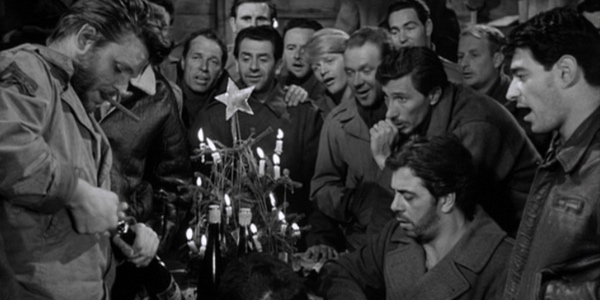
For a lack of movies to agree upon, we settled on the very routine classic, Stalag 17. We were both surprised at the extent to which this is a Christmas movie. It is! Gifts are exchanged, there’s a tree, singing and dancing, extra snacks for the prisoners. So there you go.
Stalag 17 is visually too committed to the stage production from which it was adapted. It has a narrator that is totally unnecessary (actually, that character could be removed entirely) and William Holden was nearly disgusted that he won–he thought Burt Lancaster deserved it for From Here to Eternity, which is true (Holden thought he also deserved it for better performances he’d done in the past–also true.)
Like Christmas in Connecticut, this is a movie that totally softens a wartime experience. I guess one of the scriptwriters, or the authors of the play, were in Stalag 17, and it’s amazing there was a time, so close to this immense tragedy, where they could make a movie like this. I mean, its great inspiration is Hogan’s Heroes. Ouch.
The Getaway (1972), dir. by Sam Peckinpah.Streaming at home, Saturday, November 19.
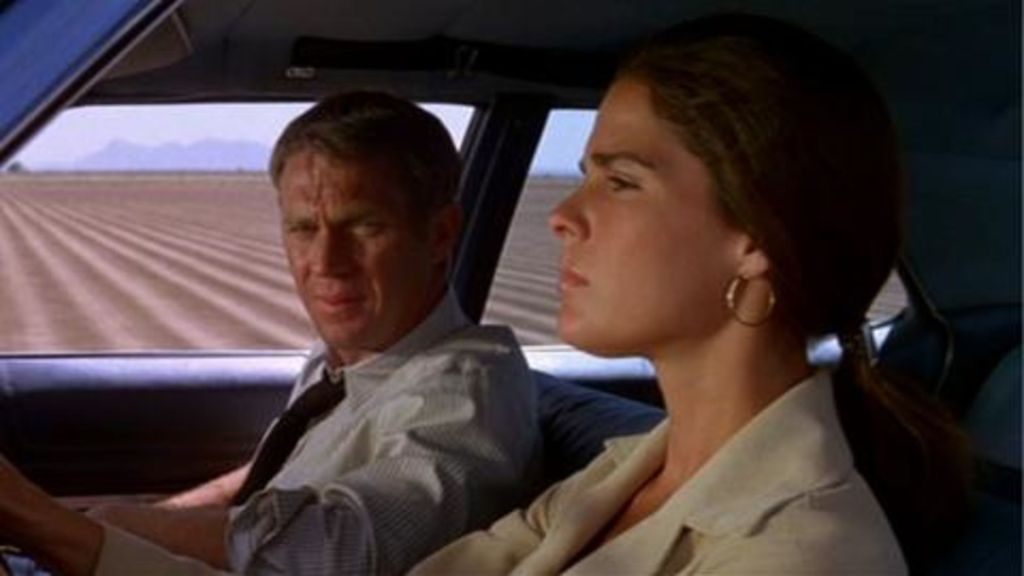
After reading Quentin Tarantino’s fabulous Cinema Speculation, my reaction to Sam Peckinpah’s The Getaway is very similar to my experience to that of Howard Hawks’ The Big Sleep (1946). When I was in college at Michigan State University, I went to the Curious Book Shop with a little bit of money and bought a second-hand copy of Raymond Chandler’s The Big Sleep. It blew me away. I’ve since read all of Chandler’s stuff, and I reread his novels constantly. Though there are many books that have meant more to me as a human and a writer—The Little Prince, The Plague, The Autobiography of Malcolm X, Up in the Old Hotel, to name a few—if I’m honest, Chandler is probably my favorite writer, whose work I’ll read in part every year until I’m gone.
Vengeance is Mine (1984), dir. by Michael Roemer.Trylon Cinema, Friday, November 18.
In media res—the practice of beginning an epic or other narrative by plunging into a crucial situation that is part of a related chain of events. -Encyclopedia Britannica
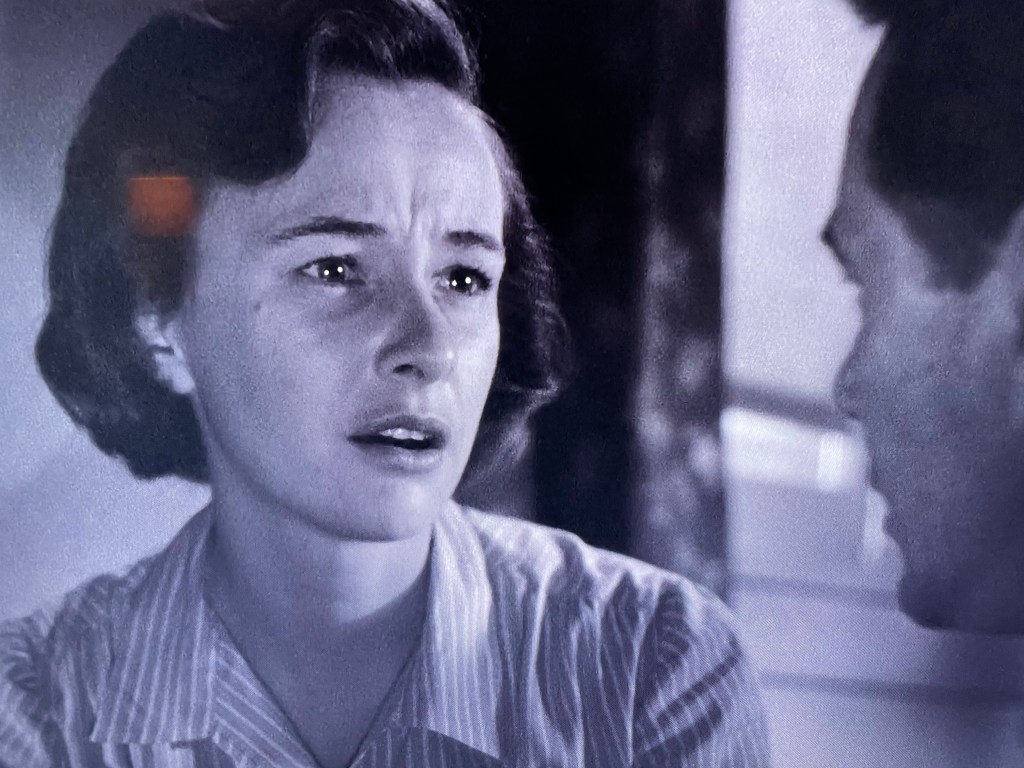
We open with a shot of a woman’s face. This is Jo (Brooke Adams), who we’ll learn was once Mary Jo, now just Jo. She’s drinking. The plane is about to land in a place that makes Jo want to drink.
Her mother is dying. Actually, it’s her adopted mother, and Jo also has a sister who is that woman’s biological daughter—so even in her family she’s an outcast. There’s also a step-dad. Mom clearly doesn’t want to have anything to do with Jo. She doesn’t want to hear that Jo has found her birth mother. She doesn’t seem to want Jo around in her last days.
Jo and her sister go to a drugstore restaurant for coffee. There, a man filthy from repairing automobiles is sitting at a table with a miserable looking family. He sees Jo, and when she goes to get some aspirin (she’s gonna need it), he runs to her and says hello. She brushes him off and when he sister asks who he is, she tells him that’s the guy who got her pregnant years ago. ““No,” she says. “He’s the guy I got to get me pregnant.”
Weird (2022), dir. by Eric Appel.Streaming at home, Wednesday, November 16.
I am surprised to admit that I really enjoyed the first 40 minutes of the 108 minute Weird Al Yankovic bio-pic, Weird. I appreciated that it’s a sharp parody of rock bio-pics, that it cast a bunch of comedians in small roles (that they seemed to enjoy) and that the set pieces are wonderful–there’s a pool party scene at Dr. Demento’s house, inspired by Boogie Nights, with Jack Black as Wolfman Jack, and I could watch that whole scene a dozen times.
But I would not say that Weird is like the bio-pic version of a Weird Al Yankovic song… no, it’s more like a bio-pic version of a Weird Al Yankovic album. Did anyone ever really buy an album of Yankovic’s? I guess they must have–I read that his later concerts take “deep dives” into his oeuvre. And I gotta say, that’s really fucking weird. I mean, when I was growing up, I was amused by Yankovic, and I was glad that he existed, and laughed at the songs I heard on the radio or MTV. Once, maybe. After that, didn’t “I Lost on Jeopardy” become as tedious to you as it did to me upon multiple spins? The thought of a person going any deeper than, say, “Eat It”, strikes me as that individual needing to find other, more interesting sources of comedy. I mean, I keep reading about musicians who loved being covered by Yankovic, but wouldn’t that affection have been limited to the parody singles that actually charted and got airplay that they went crazy for? The album that “Eat It” comes from, Weird Al Yankovic in 3-D, looks utterly insufferable to sit through. Do we really need a “Safety Dance” parody? No one reminisces about his covers of the Police’s “King of Pain” or Survivor’s “Eye of the Tiger”, right? A little bit of Weird Al goes a long, long way, and that’s definitely the case with Weird, too.
But, I’m happy that people love his work even if I can’t remotely understand their profound adoration. Weird is fun, it’s worth watching even if it flags in the second half, it’s a shame it couldn’t be seen in theaters with a bunch of other Yankovicians (or whatever they call themselves, if they call themselves anything), and Daniel Radcliffe is way too ripped for comfort.
Singin’ in the Rain (1952), dir. by Gene Kelly and Stanley Donen.Heights Theater, Monday, November 14.
…that this perfect movie can only be improved by the presence of, oh, I’d say a nine-year-old boy who was just beside himself with laughter at Donald O’Connor’s “Make ‘Em Laugh!” moment. I mean, this kid was screaming with joy. And that makes me feel like this is one movie that will bring people joy for many more years to come. I hope that little boy carries this memory with him forever, as I did about seeing this movie probably 45 years ago in Saginaw.
The Elephant 6 Recording Company, 2022, dir. Chad Stockfleth. Sound Unseen screening at St. Anthony Main, Saturday, November 12.
I know very little about the indie record label Elephant 6, but back in the day I did enjoy Neutral Milk Hotel’s legendary album, In the Aeroplane Over the Sea. That’s the full extent of my knowledge of that label’s releases, but despite that I went with my pal Mike and his wife, Tammy, and stepson Jackson to see the film at the Sound Unseen music and movie festival last Saturday. It’s great to check out stuff you wouldn’t normally hit on your own.
The movie, simply titled The Elephant 6 Recording Company, apparently took 10 years to make, and in my mind I wish that other rock documentarians would look at it and notice how well it works as a silly, fun, appreciative look at this record label and its many successes. There is no narrative slammed onto the story, such as it is, but a lot of music, good interviews in weird places, art design, great covers and 45s, a look at strange equipment and a lot of time spent in the run-down homes people crashed in back when they were young and didn’t mind falling asleep drunk under a leaky sink in a laundry room. It’s fabulous, entertaining and made me want to look up more of the music they released. What more do you want in a rock doc?
Bullitt, 1968, dir. Peter Yates. Streaming at home on Thursday, November 10.
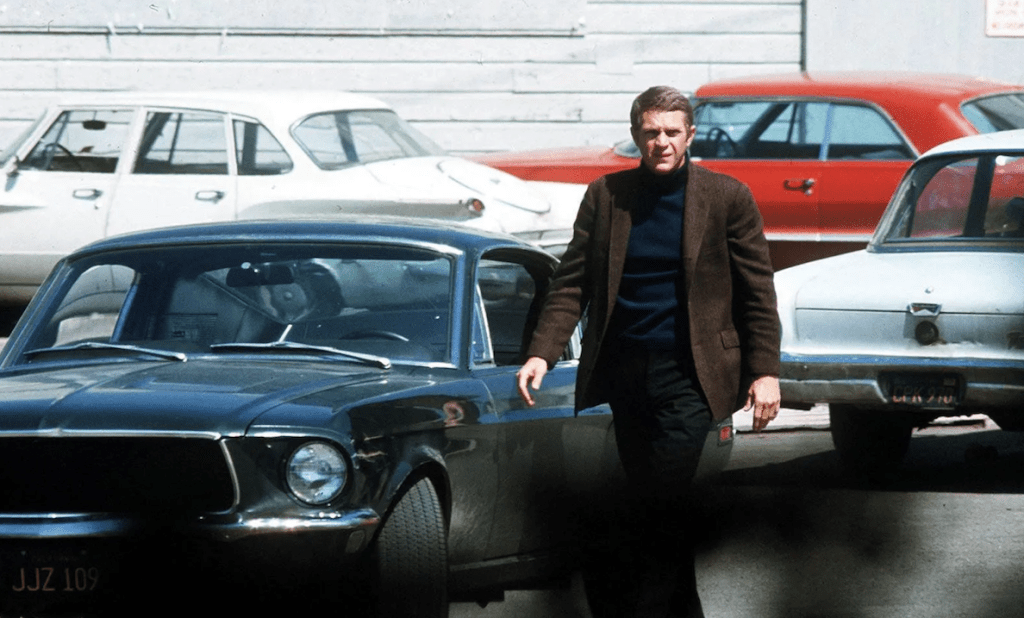
So recently I picked up Quentin Tarantino’s book, Cinema Speculation. I have complicated feelings for Tarantino–on one hand, he seems like a macho dickhead, he uses the ‘n’ word way too much, he was a shit to Uma Thurmond, he can be a prick in interviews and, probably, in life. He seems like a spoiled brat.
On the other hand, well, he also seems like all those things and a cinematic genius whose films are deliciously entertaining. When I hear there’s a new Tarantino movie coming out, I admit that I’m excited. I admit that I am really excited. When they come to town, I catch them right away, and only once have they disappointed (The Hateful 8 is as bad a movie from a great director that’s ever been made). Inglourious Basterds is one of my favorite films. His movies are funny, they’re exciting, directed with ultimate panache, there’s a very definitive worldview, he elicits amazing performances from his actors (and discovers new ones or gives old, forgotten ones top billing), no one makes movies like him, and the critical whirlwind cannot knock down the very enjoyable experience of seeing one of his pictures.
The Man Who Cheated Himself, 1950, dir. Felix E. Feist. Streaming on Kanopy at Tom’s House, Tuesday, November 8.
Wow, Felix E. Feist, what a name behind the picture! Anything’s better than Todd Field, right? Watched this goofy little noir after Tár, which was an improvement. The Man Who Cheated Himself isn’t anyone’s idea of a good movie, just a little noir with great location shooting in San Francisco. One guy who is a homicide detective protects his wealthy girlfriend when she murders her soon-to-be-ex-husband, and then the cop’s brother, who is also a homicide dick, investigates. Bad guy cop is Lee J. Cobb, and he’s a ladykiller. Good brother cop is John Dall, and he’s newly married. Cobb is all wrong as the ladykiller, Dall’s aw-shucks attitude gets old quickly, there’s some great lighting and the conclusion at the abandoned ruins of Fort Point, beneath the towering steel beams of Golden Gate Bridge loom is just fabulous. Fort Point is the building in Vertigo where Madeline dropped into the bay and Jimmy Stewart fished her out. Restored by the Film Noir Foundation, and I’m assuming it’s because of moments like the Fort Point scene. Still, I’d watch this B-picture a hundred times before I’d see a dozen Oscar nominated films.
Tár, 2022, dir. Todd Field. Heights Theater, Tuesday, November 8.
So Todd Field hasn’t made a movie in 16 years. His prior works were In the Bedroom (2001) and Little Children (2006), two of the worst examples of modern Oscar bait you can find, the latter perhaps the most mean-spirited work I’ve seen since Ruben Östlund decided to poop on modern art museums. Is there anyone who was eagerly awaiting the return of Todd Field? Yes, I’m sick of super hero flicks and yes, I’m tired of tentpole franchise films and yes, I want to have my thoughts provoked. But Tár is just a bad movie. Oh, it’s smart. But it’s not wise, warm, surprising, amusing, funny, or fascinating in any way. And really, if you all you are is smart, that’s actually pretty dumb.
People I trust look at Tár as satire, a genuine satire of the world of classical music. I’m not seeing that, and if it’s satire then I fail to see the point–I mean, attendance is down in orchestras everywhere, it’s not as though conductors wield special power in the world of music (or otherwise), and if you mean to tear down this lofty society of wealthy people, I mean, OK, have at it. If this is the case I think the movie is easily dismissed–it’s never very funny, and, like Östlund’s The Square, it’s a satire of a thing that’s easy to parody, and worse, one its very audience adores. I mean, honestly, Field listens to classical music and reads The New Yorker and so does pretty much everyone who watches this movie, including me. Is the satire meant to comfort, the way Stuff White People Like is truly only enjoyed by white people who hope enjoying Stuff White People Like makes them seem less… white?
The Breaking Point, 1950, dir. Michael Curtiz. Criterion Channel at home, Sunday, November 6.
When we think of film noir, we conjure up many images: tough men plotting murder or a cunning heist, scheming femme fatales, handguns and blackjacks, close-ups of nervous-looking character actors, cops closing in, that chiaroscuro lighting, alleyways, seedy bars and nightclubs, those automobiles with their massive interiors.
But the best film noir, to me, are the ones that carry us deep into the genuine squalor that moves desperate people into the unthinkable. The greatest noirs remind us that crime isn’t here for our entertainment, it’s the result of dreams curdled into nightmares, of literal hunger, homelessness, of watching children squirm beneath the weight of poverty, their parents losing their grip because of this. Much as I love The Big Sleep, Double Indemnity, The Maltese Falcon and the great crime films of Jean-Pierre Melville and Seijun Suzuki, in my heart is a special place for the smaller, cheaper, more squalorous noirs like Kansas City Confidential, Try and Get Me!, and Cry Danger, those poverty row productions focused on the lives of people I can relate to very well.





 Movies with People Watching Movies