
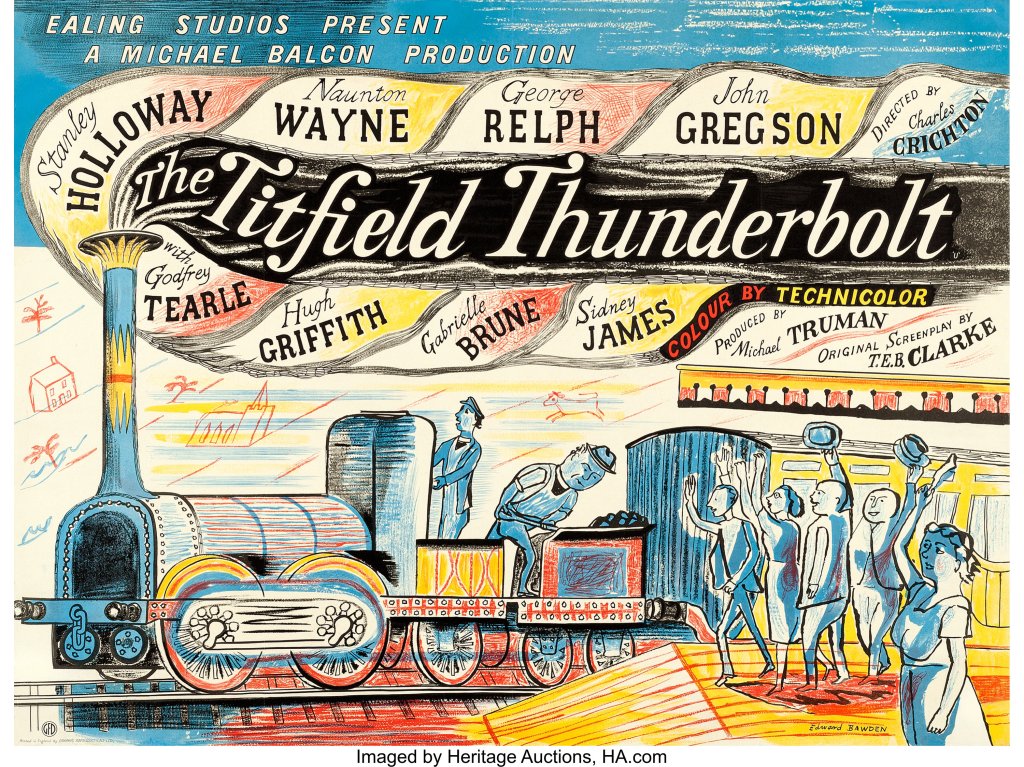
The Titfield Thunderbolt (1953), directed by Charles Crichton. English blu-ray at home, Thursday, May 25.
God damn it, The Titfield Thunderbolt. I wrote recently of Ealing comedies, and how the very best of them are really fun but kinda shallow, very pleasant and never truly dark or edgy. Problem is, when they’re not great they tend to be less than moderately entertaining, too cute by half, and then utterly forgettable. But The Titfield Thunderbolt! Holy shit, this movie starts off as a pleasing little movie and then goes right off the rails, literally and figuratively. Its terrible ending makes this a pretty bad movie.
The story is this: a small English village called Titfield is about to lose its branch line railroad to the nearest large town, called Mallingford. This news prompts a couple of seemingly smart fellows to buy a shiny new bus and make that the primary mode of transport to the city. But the railway enthusiasts are heartbroken, they speak with sadness and wonder at the old train, one they loved and adored and, in the case of a local vicar, studied so diligently that he knows how to run the thing, knows its engine inside-and-out. A father of one of the villagers started the railway. Well, one of the men hatches a plan: buy the train, privatize it, and run it. Where to get the money? Why from a local wealthy man who absolutely adores railroads is an alcoholic.
Wait, what? Yes. In the summaries I’ve read, these rail fans convince a wealthy rail fan to buy the train. No, actually, they convince a man who is a total drunk to buy the train because they can put a bar in one of the cars and start serving booze at 9. That’s why he buys the train.
Well, the government (criticized throughout–this is a very Tory film) steps in and, horribly, wants to make sure that the train is being run safely and on time. God, the awful deep state. Granted, all of the UK was still going through rationing at the time, and they must’ve felt pretty shitty that they won the war and had to stand back and watch America, Germany, France and Japan all rebound while they scrimp on their meals for reasons I still don’t understand. Anyway, the government insists on having an inspector come later to scrutinize the operation and make sure things are going smoothly. This prompts the bus operators to step in and try to throw a wrench in the works, so they plot and scheme to try and physically destroy the train. And of course, they succeed.
Wait, what? Yes, that’s right, they try and try to stop the train running on time, and then finally derail the damn thing. Both Janice and I were stunned at this plot twist–I mean, the train gets thrown a good fifty feet off the track, all the cars on their sides, a man was almost killed in the process. How the hell are our heroes going to get out of this jam? Man, that’s weird.
This is where what was a kind of bewilderingly charming little movie becomes an exercise in tone-it-the-fuck-down filmmaking. The solution is this: there’s a local museum that has an older antique engine in it, plus there’s a man who sleeps in an abandoned passenger car in a field. Put them together overnight, and the train will run in time for the government inspector!
Wait, what? Oh, I forgot to mention that one guy’s alternative idea is to steal a locomotive from a rail yard by driving it off the rails and through the town on the roads. He does this in the film. No, I did not stop to watch Inception. This only fails because he’s also drunk and crashes the train, after it leaves the road and enters a field, into a tree.
So, back to the other plan: the volunteers, men and women both, using poles, carry the engine from the museum onto the track. Also, the volunteers, men and women both, using poles, carry the passenger car from the field to the tracks. Yes, those things happened. Apparently, 20 or so people can just lift a small railroad engine in England.
The plan succeeds, of course, but not in any way that’s genuinely amusing or satisfactory. Plus, the screenwriter and filmmakers fail to understand their characters, which is worse. The two men who bought the bus are established right away as just a pair of hardworking fellows who had a good idea when confronted with the news that the train was going away. A bus line isn’t an inherently bad thing, and time has not helped this scene–I even remarked out loud “wow, look at that gorgeous bus.” It’s really cool looking. But these guys are bad! They go from competitors to schemers to downright awful human beings. Tonally, it’s really off.
Then there’s the train. For most of The Titfield Thunderbolt, we have the volunteers and railfans working their tails off to make this particular train go. To make the train go that one man’s father started and a vicar has studied and loved in that special way that people love specific machines. When it’s derailed, they just move on to another train. The implication in the first half is not just that they enjoy taking trains, but that they like this particular train–in fact, a bishop comes in from a long way just to help out on the first train, he loves it so much. Just shoving another train on the track and everyone loving it suggests that the screenwriter didn’t have a clue about his characters or their situation. Which is another reason the ending guts this film–the motivations of the first part are jettisoned for bloated comedy.
The Titfield Thunderbolt boasts stunning color cinematography, takes place in a gorgeous countryside and lovely little town, the trains are cool, and some of the characters are really neat. Until they’re not, because they were boxed into a corner, plot-wise, and the result is a movie whose ludicrousness is what follows you after it’s over.
 Movies with People Watching Movies