
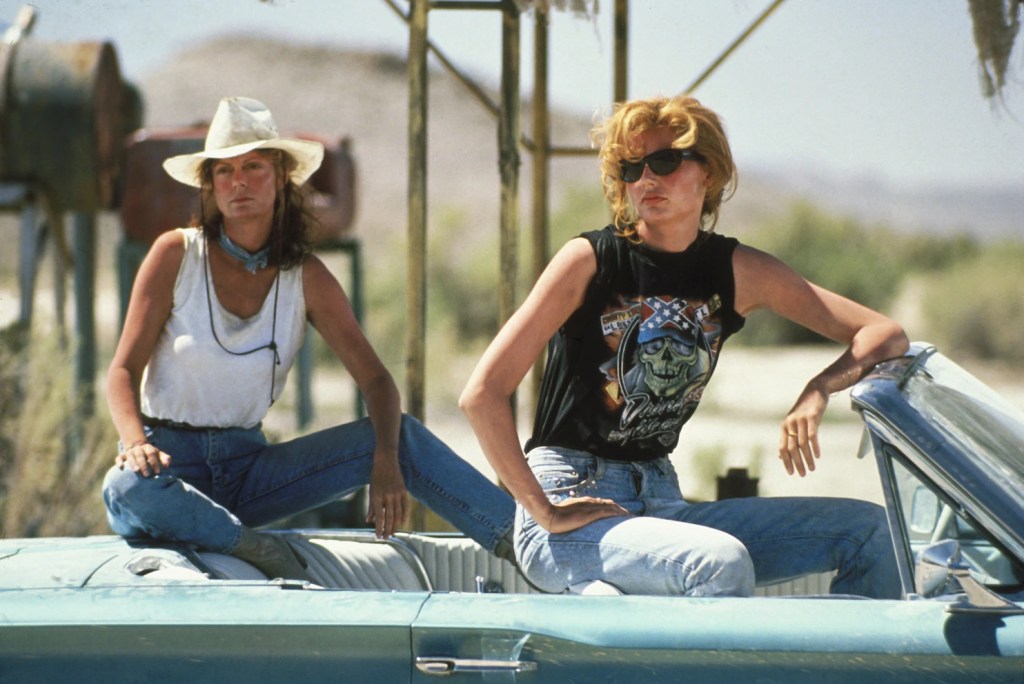
Thelma & Louise (1991), directed by Ridley Scott. Streaming at home, Wednesday, April 12.
I hadn’t seen Thelma & Louise since it came out in the early 90s, halfway through the one and only term of President George H. W. Bush. Watching it again the other night, I was really entertained–in fact, I want to watch it again. It made me realize that a Susan Sarandon series would be pretty interesting (I mean, Rocky Horror, Atlantic City, Bull Durham and this one makes four good films). It’s also a fascinating movie in terms of its backstory and what you see on the screen.
- In my mind Thelma & Louise seemed to exist in this small realm of decent 90s neo-noirs, which includes Miami Blues, One False Move and After Dark, My Sweet. Those are all great films. But there’s a number of differences between those films, including the fact that they’re more modest, low-budget art-house or near-B movies, and Thelma & Louise is a big-budget film from a big-budget director. Hell, the script was purchased for a half a million dollars, and the budgets for those three are about the price for the script alone. Nothing wrong with that, it’s just that on this watching I realized how important the budget is to this plot. Because having big stars like Geena Davis and Susan Sarandon, as the eponymous outlaws, really compels us through this film and makes it a consistent surprise. I was honestly stunned at how great they are in this film, both because they’re remarkable actors putting in solid performances, but also because they command our attention in an old-school way, the way that Golden Age Hollywood actors used to do by being huge presences. In fact, though they’re both very effective in other movies, here they seem to almost transcend their own skills and riff on these characters in the way a great musician can riff on a certain song or theme. They’re truly amazing.
- Thelma & Louise is a very entertaining film, and one that totally commits to its story. The famous ending is both a shock and the only possible resolution–if this film was made in the decade prior, it wouldn’t have had anything but a happy ending. If it had been made in the 1970s, the film would have been excessively bleak and the ending would be coming at us like a freight train, and have had much less impact. Then again, back then it might have starred Ellen Burstyn and Shelly Duvall, which would have been something to see. Instead, Thelma & Louise is a bright, 90s Hollywood summer film that welcomes in that era’s empty optimism, then seems to say, “well, where did you think this was going?” and then, zoom, right off the cliff. Which might be a perfect metaphor for the end of the Reagan-Bush years.
- A lot has been made over Thelma & Louise being a surprise hit and a triumph over naysayers, etc. Honestly, I find this hard to believe. Ridley Scott paid big bucks for the script early on, every major actress wanted to be in it (holy shit, including a brief sojourn where this could’ve starred Meryl Streep and Goldie Hawn–ouch), it was submitted to Cannes and then opened across the country in May of that year, making a bunch of money. It opened wide–it did not open in one or two cities and then slowly grow in popularity due to word-of-mouth promotion. It was an immediate success and was nominated for six Oscars. Its success was expected, marketed and realized. There’s nothing wrong with that, I just think it’s an overstatement to suggest it surprised people. Hollywood loathes surprises and worked awfully hard to make sure this was in no way surprising financially, critically or otherwise.
- Much as I enjoyed Thelma & Louise, I can’t in any way call this a perfect picture, in part because it has so many dumb faults and technical glitches. There are a number of really awkward edits, as if someone were rushed–usually there’s a second or half second after someone speaks their dialogue before you transition to another scene, but there’s maybe four or five times where a character, usually one of the federal agents, is talking and, at the close of the last syllable, boom, we’re suddenly in Louise’s convertible and they’re talking. It’s jarring. There’s so many awkward camera angles in this movie. And, sadly, part of the cost of the movie went to the Smokey and the Bandit chase scene and the dumb moment where they blow up a trucker’s rig.
- Speaking of that trucker’s rig, after this scene, in which Thelma and Louise confront a repulsive trucker and then blow up his rig, they drive away and then Thelma grabs the trucker’s sweaty cap and puts it on. That’s fucking gross.
- Callie Khoury’s script is often spot-on, funny, emotional and exciting until it takes one massive dump: Thelma & Louise is famously the movie that introduced the world to Brad Pitt, and his subplot is awful. The plot, as you may know, is that Louise (Sarandon), in her Ford Thunderbird convertible, has dragged poor Thelma (Davis) on a girl’s trip to a friend’s cabin. When they stop at a honky-tonk, Thelma is nearly raped and Louise kills the assailant, and they go on the run. All this time it is well established that Louise is the organized one, the tough one, the trustworthy one, and Thelma is the flake, the good-hearted but simpleminded one, the kind of person, as my Dad once said, “you could trust with your life but not your money.” Deciding that they need to flee to Mexico, Louise convinces her boyfriend, Jimmy, to get her life savings, $6,000, out of the bank and wire it to her at a remote hotel in Oklahoma. Instead of doing this, Jimmy delivers it in person, and he and Louise get a room together. Thelma gets her own room and she invites sexy hitchhiker J. D. (Pitt) to her room. But before she does this, Louise brings Thelma the envelope of money and tells her to “guard this”.
Why in the living fuck would she do this? Even without J. D. in the picture, Louise wouldn’t leave that pile of cash with Thelma, whom Louise had been riding about her bad choices the whole of the picture up to this point. I mean, why wouldn’t Louise just keep it her own room? Because she doesn’t trust Jimmy, who is sleeping there, too? Except that he’s the guy who brought her the money in the first place. In a structural sense, J. D. stealing the cash makes the pair broke, destitute and now needing to rob service stations and become further empowered but also now definitely on the wrong side of the law. Before they might have said the murder of the would-be rapist was self-defense (and it’s to the movie’s great credit that the killing isn’t quite self-defense), but robbing a service station is certainly sending the two of them to prison, and wrecking their lives. But the method by which Khoury puts them in this position is ludicrous. It’s one of the few things I actually remember from watching it 30+ years ago, it’s that frustrating. - I forgot that Michael Madsen used to be a pretty interesting actor. And his character could probably only have been written by a woman–he’s a “good guy”, but when he visits Louise on the trip, he’s also a manipulative prick who thinks it’s appropriate to propose to her right then and there. He’s a petulant child, and his behavior further makes us feel Louise’s increasing isolation. I think if a man wrote this he’d make us care more about Madsen’s character, in ways that would interfere with this great story. The script for Thelma & Louise is all of what I mentioned before–clever, exciting, fun, but it’s also got these wonderful moments of genuine human complexity–it’s true, and worth studying.
- There sure is a bunch of Reagan-Bush era politics in this movie, though. On one hand, I like its big-budget, big studio Hollywood style look–the need to make things big, even in this small story. The pair are escaping in a 1966 Ford Thunderbird convertible. Yeah, it’s the opposite of inconspicuous, but it’s cool, and this movie is driven by this triangle of cool, the three sides of which are Susan Sarandon, Geena Davis and that T-Bird. Brad Pitt and Michael Madsen play the ingenues, the hommes fatale that would have been blonde-haired women to fugitive men in 40s noirs. Then there’s Louise’s backstory–they can’t drive through Texas as they escape to Mexico from Oklahoma. Why not? Because Louise was sexually assaulted in Texas and she won’t go back. Other than deepening her character, and giving further reason as to why she shot Thelma’s assailant earlier, this also means these two stars, in their awesome car, now must avoid the Lone Star State (boring visually) and detour through Monument Valley (very much not boring visually), the land of John Ford and the great American western. The weather must be perfect, of course, to allow them to always drive with the top down. This detour also takes them right to the edge of the Grand Canyon, and sets us up for their breathtaking destruction. And it is breathtaking, I was surprised at how moved I was by the ending on this second viewing. I mean, all of that’s just great cinematic storytelling, even if it doesn’t quite make sense. It’s like the way the bad guys have a home on top of Mount Rushmore in North by Northwest. Thelma & Louise is a classic today because Khoury and Scott committed to its sense of cool. Bravo.
But that bravado also a reflection of its time. Just as we can’t conclude the high school story of Marty McFly in Back to the Future without his being rewarded with a brand new Jeep, so, too, in Reagan and Bush’s “morning in America” can a waitress own a pretty Ford Thunderbird convertible (or, for that matter, can Thelma’s carpet-salesman husband own his own convertible and large home). This is a film of men who are horrible, who are perverts, who are manipulative, who are thieves… but the very good, understanding man is a cop, because cops are no longer 70s bumblers or evil, tobacco-chewing freaks (then again, the very next year Keitel would become the Bad Lieutenant). Even when Thelma and Louise are pulled over in Monument Valley, that cop is merely a tool, and a crybaby, but not really a threat, sexual or otherwise. It’s weirdly pro-cop, this movie. There’s even a scene where a group of cops are all watching what sounds like a Joan Crawford weepie in Thelma’s home with her husband (they’re staking out the place hoping she’ll show up), and in disgust he changes the channel to football. All of the cops–the fucking cops!–turn and give him the stink-eye. They’d rather watch Joan Crawford than football. - Another sign of the times: Thelma is wearing a t-shirt with a Confederate flag on it when she meets her fate.
- Another sign of the times: holy crap, that score. Piles and piles of the worst white-man- and woman-blues, cobbled together for an inevitable soundtrack, along with Hans Zimmer’s awful, faux-bluesy steel guitar score. Which is kind of another sign of this film’s considerable budget. It does have Johnny Nash’s “I Can See Clearly Now”, which I love, but ouch, Glenn Frey and Michael McDonald? Ugh.
- Ultimately, though, Thelma & Louise is a blast, and even with its ending, it’s clearly a film meant to be cool, fun and heroic. It’s not like Bonnie and Clyde, which is bleak and despairing and shows our heroes as deeply flawed people, their victims’ faces twisted in pain. This is movie made in the classic old-Hollywood style, auteurs be damned. Thelma and Louise are a fun pair, but are never truly challenged as characters, neither really has a dark side to them (Thelma is a ditz, but she’s a sweetheart), but I’m totally fine with that.
 Movies with People Watching Movies