
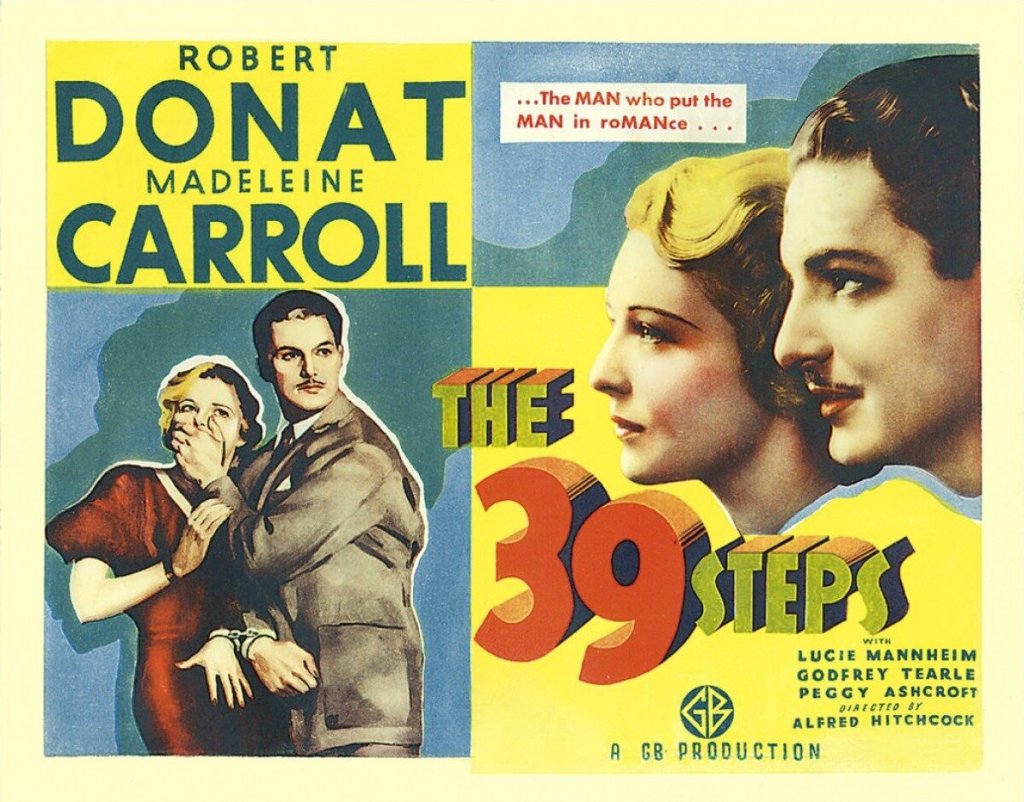
The 39 Steps (1935), directed by Alfred Hitchcock. Heights Theater, Thursday, April 6.
I love watching Hitchcock films at the Heights Theater, sold-out screenings with everyone so excited and flipped out to be watching them on the big screen in such a gorgeous place. And there’s always someone who gasps, someone who hasn’t seen Vertigo or Rear Window or North by Northwest and is stunned at a plot twist.
Well, that was me with The 39 Steps–I’ve never seen it, always wanted to, always missed it when it screened in town. It’s fun, not at all the masterpiece Orson Welles claimed it was, but a brisk film in which an affable Canadian is mistaken as a murderer and has to expose a secret spy ring called the 39 Steps, for no reason I could discern. There’s shots in a run-down British music hall and later at the Palladium, really stunning crowd scenes, effective use of a train and train bridge, sets in place of Scotland, and some sexy moments involving a woman and a man handcuffed together.
But it’s a weirdly cruel movie, too, fitting squarely in with Hitchcock’s other British films. My understanding is that his work was tempered and given more emotional gravity by David O. Selznick, and you certainly see that in Rebecca and then Notorious through the 60s (in his good movies, anyway). I’ve never seen the first Man Who Knew Too Much, but I’ve heard it’s cruel as well, and Frenzy, much as I love that movie, is just nasty in spots. Here, in between the “fun”, we see the heroine legitimately feeling threatened by our hero (though critic David Thomson does point out that “[the hero] is not quite the rapist with the drop-dead one-liners that Bond would become.”) and another woman is cruelly left to the hands of her abusive, devoutly religious husband. So while I enjoyed seeing The 39 Steps, I couldn’t quite shake an uneasiness from watching it.
 Movies with People Watching Movies