
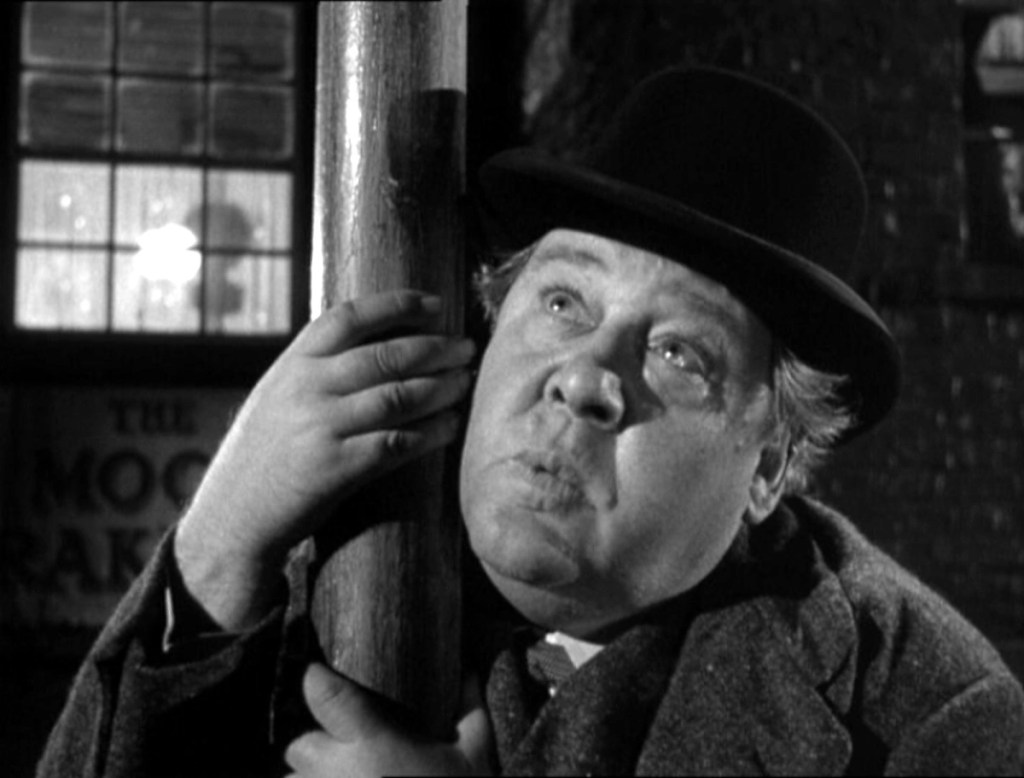
The Suspect (1944), directed by Robert Siodmak. Wednesday, February 22, Criterion Channel at home.
and,
Hobson’s Choice (1954), directed by David Lean. Wednesday, February 22, Criterion Channel at home.
It was recommended to me to watch The Suspect, as it’s new on Criterion, part of a collection celebrating the great noir director Robert Siodmak. Siodmak directed some really solid movies: People on Sunday (1930, with Edgar G. Ulmer and a sad look at Berlin before the Nazis took over), Phantom Lady, Christmas Holiday (weird but fun noir with Deanna Durbin and Gene Kelly!), The Killers and Criss Cross, the last of which is just an insane, beautiful, heartbreaking noir. Well, I watched The Suspect, was bowled over by it and by star Charles Laughton’s emotional and modern performance, and then decided, what the hell, I’m going to watch Hobson’s Choice, which I’ve seen before and loved, even thought it’s a far cry different. But what was so weird was the very different approaches to marriage that these films take.
The Suspect is really a melodrama with crime, as opposed to a full-on noir. It’s the very sad story of Philip Marshall (Laughton), who works at a tobacconist, and who is trying desperately to just exist with happiness. He is a remarkably empathetic man–his neighbor, a vicious drunk, abuses his poor wife, who is a good friend of Mr. Marshall. He is a kind boss, he is friendly and a good listener, he is a kind, loving man, and this is illustrated not only in his actions but in Laughton’s subtle performance–his eyes, his forehead, his entire face exudes the feelings within this man, and many of those feelings are doused in compassion.
His wife is a horrible human being. She is mean, cruel, so awful that she drives their adult son to live elsewhere and to accept a job in Canada (the movie takes place in London), just so he can get away from her.
Well, poor Mr. Marshall meets Mary Gray (Ella Raines), who is desperate for a job. He cannot help her, they don’t need anyone. Later, reluctantly walking home (it’s understood that it’s better to just stay at work as long as he can, and he’s known as being the first to arrive, last to leave so as to avoid the mess at home), Mr. Marshall runs into a crying Mary. They walk, they talk, he helps her to find work later. And they become friends, and then, lovers.
One might look at Ella Raines’ Mary and Laughton’s Mr. Marshall and think, well, he’s taking advantage of her, so she him. He’s not got a ton of money, but maybe she wants a better life with this middle-class man. Not a chance. Raines as Mary puts in another performance of subtlety, and she shows just how attractive a man like Mr. Marshall could be–his wit, his kindness, his intelligence make him a lot more attractive–mentally and even physically–than the sex-hungry young men she meets in her job at a department store. It is Mary who is pursuing this relationship, and Mr. Marshall responds.
Things don’t go well, of course. It’s easy to see that Marshall’s going to murder his wife, but what’s stunning is how he tries, desperately, to convince Mrs. Marshall to grant him a divorce. He reasons with her, that they both deserve happiness, and that she cannot be happy with him, right? It’s a pretty amazing scene, then and now, and it really strikes home how unfair life was back then.
I was struck by how, in 1944, getting a divorce would be nearly impossible (the film takes place in the 1920s, I think), but the movie isn’t content to just make this about a very married middle-aged man falling for some femme fatale, instead it works to craft a story of very real people whose love is crushed in a terrible system that traps people if they’ve made a mistake in marriage. Both Laughton’s Mr. Marshall and the kind Mrs. Simmons (she’s the neighbor who is beaten by her drunk husband) are clearly victims of a society that favors the idea of marriage as a moral thing over actual happiness, which is more moral than forcing people into these circumstances.
The Suspect is gorgeous and heartbreaking because all of the performances are effective but Laughton’s is astonishing. Daniel Day-Lewis once remarked that he was the first “modern” actor, and you can see it here, in the way he embodies this character, body and soul.
Hobson’s Choice is a very different film. It’s a warm, cute, often hilarious, but eventually very thought-provoking picture about love, about money, and about genuine partnerships in all aspects of life. Laughton is great here, but this is far from a modern performance, nor is it one of any great emotional range–it’s all buffoonery on his part. And thank cats for that!
Laughton plays Henry Hobson, a boot seller in a ‘burb of Manchester, and an awful drunkard. He has three grown daughters, and is a widower. His three daughters cause him no end of trouble, though this is because they’re women and, like the men with whom he socializes (read: drinks into blindness) at the Moonraker Pub, he hates women and only wants to make his money, get drunk and eat his three meals a day, and move through life. Women are an annoyance unless they’re making meat pies and pudding.
One day, one of his wealthy customers comes into the shop, an elderly woman. She demands to know who personally made the pair of boots she’s wearing. Hobson, ever the sycophant, tries to placate her, not realizing that she only wants to know because the boots are the best she’s ever had. So Hobson stomps on the floor, and from a trap door emerges Will Mossop (John Mills). The old woman hands Mossop her card and tells him that he alone is to make her boots, and that if he should leave the employment of Hobson, to look her up.
Oh, boy, does this get the wheels turning for Maggie (Brenda de Banzie). She’s the oldest daughter of Hobson. See, the two youngest daughters are “cute” and have fiancés, both of whom are successful. Maggie’s the “old maid”. And Brenda de Banzie plays her with precision–tough, intelligent, but always seeming on the edge of a sly smile. She’s going to work with this Will Mossop. She’s going to use to him against her father. She going to marry this blighter.
And so she does. Maggie immediately sets her plan into action, calling the bewildered Will upstairs and telling him that he’s her man, that she’s going to take him and make something of him. Naturally, and with a profound sense of confusion, he resists. First, women don’t do that. Second… well, women don’t do that. Third, well, he has his own bride-to-be. Finally, gosh, women just don’t do that!
Maggie does. She convinces our man to take her out on Sunday to the park, then walks, actually leads, our man back to his dingy flat, where he’s staying with a landlady and her daft daughter, whom he was going to marry. Thing is, though this isn’t really an arranged marriage (to the landlady’s daughter), truly he’s not engaged because he loves this girl, it’s because Will Mossop just kind of floats. The landlady is a powerful personality, she’s got him. Except that his good fortune is that he was apprenticed to a bootmaker and has incredible hands that know leather like no one else and there’s one person who sees this, sees he’s a good man, and knows he’s got a wonderful future ahead of him. And this talent does something for him, the way physical attractiveness does something for men and women who can attract mates just on their looks–Mossop is attractive to Maggie, genuinely attractive, because he’s good at something, beautifully good at something, making boots. So when the landlady raises her voice, so, too, does Maggie, and her passionate defense of Will makes the man pause, barely able to believe that a person could think so highly of him. It’s a gorgeous moment, moving, David Lean bringing us into a close-up of John Mills’ face as looks confused, then moved, then a slight smile breaks on his face for the first time in the movie.
And therein lies the wonderful plot. Maggie has her man, he reluctantly, then not-so-reluctantly, then very eagerly joins her. Her father won’t have it, neither will her sisters, until Maggie concocts a cunning plan that will help them get married, too (Hobson won’t pay anything for their dowries, so marriage is difficult). It all works out in the end, including, to my relief, the fact that Hobson is wrong at the start and buffoonish, wrong at the middle and cruel, and emerges… wrong and defeated. An American making this film would have old Hobson come about, be a better man at the end. No, we get the very real feeling that as he slowly drinks himself to death he will be listened to less and less and less until finally he just… goes.
Laughton makes him palatable, but it’s de Banzie and Mills who make this movie shine. I love the point of Hobson’s Choice–that love is often not a sweeping thing, with a rousing score, but a thing of people working well together, and loving one another in the process. Hobson Choice is truly about pride, of being proud of your partner for their accomplishments and who they are as people, no matter what package they come in. It’s not as romantic, maybe, as a “normal” love story, but it’s so heartfelt and genuine here.
Whenever Janice and I watch this film, we’re reminded of John Singleton Copley’s famous portrait of Mr. and Mrs. Thomas Mifflin. Robert Hughes, in his incredible book, American Visions, which I read aloud to Janice on our honeymoon, describes the painting thusly:
“…it radiates… earnestness, probity, equality, set forth within the microcosm of marriage, an Ideal Republic of Two.”
Janice and I always like to think of ourselves as an Ideal Republic of Two, and I think the Mossops probably did as well, even as they might not have articulated it that way.
And so, two visions of marriage: one of the trap that marriage could be, that pushes people towards violence–and I do think that The Suspect almost openly suggests that violence is Mr. Marshall’s only option–and one that suggests that marriage is better when two people put their minds towards the industry of the relationship, in a very real and figurative sense. Both feature one of our most underrated actors today–Laughton was probably overrated in his day, but now is only known as the director of the brilliant Night of the Hunter–and are just fabulous entertainments.
 Movies with People Watching Movies