
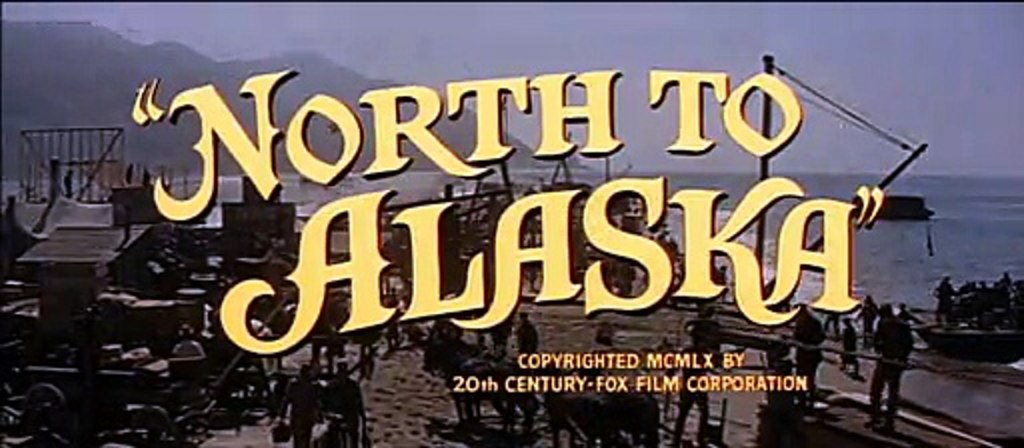
North to Alaska (1960), directed by Henry Hathaway. Streaming at home on Wednesday, February 8.
During the school year, Janice and I watch a lot of trash, some of it awful (most of it awful), some of it fun. She’s usually way too tired and emotionally battered to want to deal with, say, Aftersun, so we watch some reality TV, British TV or Star Trek: The Next Generation, which I’m enduring for the first time (Christ, that show waivers between good and bad like nothing I’ve ever seen. Sadly, most of it is thoroughly mediocre.) Oddly enough, Janice likes Westerns. Even more curious: she really likes John Wayne.
I do, too, and I’ll make a case that he was one of the great actors of Hollywood’s Golden Era, the type of actor who can pull off a movie without much great “acting”, in the method sense. No immersion into character, but rather, the same person putting on a character like they would a suit. And I think Wayne, especially in Howard Hawks movies, was a genuinely effective comedian. Case in point: North to Alaska.
North to Alaska sure shouldn’t work. Honestly, we stumbled into it because we both enjoy Johnny Horton’s riotous song of the same name. It’s a comedy, and a broad one, directed by Henry Hathaway, who is no one’s idea of a great director. Supposedly conceived in order to capitalize on Alaska’s 1959 entry into the nation (yeah, that’s guaranteed box office), this movie took years to pull together, and cost a ton, and had roomfuls of writers throwing shit at a wall. That never works. They got a hit teenage heartthrob, Fabian, to play one of the characters (the team was really cribbing from Hawks’ Rio Bravo, which recognized a great movie presence in Ricky Nelson). Fabian is a terrible actor. It has Capucine, a model who did not get along with Hathaway. For a movie that is supposed to celebrate Alaska, weirdly it was shot entirely in California, and you can sure tell. Oh, it also takes place in Seattle. Partially in what appears to be a Southern plantation home. Like the parts in “Alaska”, the part that takes place in “Seattle” was definitely not filmed in Seattle.
This movie is a product. A major studio, in this case 20th Century Fox, threw this together in the hopes of making big bucks with stars like John Wayne, Ernie Kovacs and Fabian. They spent too much money and seemed not to know what they were doing. There could probably be no more recipe for disaster than this dumb movie.
North to Alaska was a big hit, raking in millions for 20th Century Fox and John Wayne. It’s the dumbest, most ludicrous film I’ve seen in a long time, and Janice and I loved it–this boisterous film is full of happy characters, action, romance, and just people plain having fun in a way that is thoroughly contageous.
North to Alaska’s plot, such as it is, goes thusly: Sam McCord (Wayne) is a gold miner outside of Nome, who is in partnership with George Pratt (Steward Grainger) and his brother, Billy (Fabian). They’ve hit it rich–they’re millionaires. Now that they’ve found “bonanza gold”, George sends Sam to Seattle to pick up his fiancé, for whom he’s been pining for months. George can’t go because he has to stay behind to keep claim jumpers from attacking. Why Wayne’s Sam can’t do this is tossed off, but I forgot the reason. Anyway, Sam goes to Seattle, discovers that George’s girl married another and so he heads off to what appears to be a friendly brothel to have some fun.
Which he does–girls are climbing all over him, and he makes this look fun. Enter Michelle “Angel” Bonet (Capucine), who is French, as was George’s girl. Sam gets an idea: I’ll pay Michelle to come to Nome and marry George. She readily agrees, since being the wife of a millionaire is better than laboring at the Hen Club.
OK, so then they leave for Alaska, So then Sam’s old logging buddy comes in to the brothel and convinces him to go to the great, big logger’s picnic, where Sam can defend Michelle’s honor, punch a guy out, climb a tree in a sort-of logging race, and get bombed. I guess Sam used to be a logger–this was never mentioned before, after these shenanigans it’s not mentioned again. During this riotous picnic/contest/second-round-of-fisticuffs (seriously, so much shit happens at this logger’s picnic), Michelle falls in love with him and thinks he feels similarly. Seriously, this scene felt like the producers were shouting at their writers, “this movie’s only an hour long!” and someone said, “well, I’ve got that logging script you never used, should I shove that in?” “Ah, why not?” So there you go.
Off to Nome they go, and there’s arguments as Michelle thinks Sam wants to marry her, but he wants George to do it, she’s mad, then she’s OK with it, there’s a subplot involving claim jumping, she goes to their remote mine and fends off Billy, who Fabian, a terrible, terrible actor, plays with a ferocity that suggests that he’s less interested in being in love with Michelle but wants to murder her and like, wear her skin or something. He wears a face of insanity, but his wooden acting, somehow, works well here. There’s confusion, there’s fights, Michelle is about to go back home to working at the Hen House, and of course it all ends happily. And man, is it fun.
The romance was a big surprise. Janice has said it before: “I simply can’t imagine anyone sleeping with John Wayne.” True, he’s an action kinda guy, but he seems thoroughly asexual. But in North to Alaska–and in no other film I’ve ever seen, including Rio Bravo and Hatari!, two movies in which Howard Hawks tried desperately to make him romantic–he’s genuinely a sexual creature, and his chemistry with Capucine is remarkable. She’s fantastic, slipping between sexy to angry to witty to hilarious, Capucine is a force to be reckoned with here, and carries the movie with as much verve as Wayne.
And I guess this thing works because it’s genuinely funny and fun. Every set piece is well crafted and strange, in the very best way. For instance, when Sam has to break the news to George that his fiancé has married another, cue another fist fight. Well, instead of just having them duke it out in front of their cabins or in a field, it comes at the tail end of a bizarre gunfight at a neighboring claim, where the long, wooden sluices (those channels that redirect water from streams to wash away the dust from gold, or something) have been broken, and Sam and George punch and grab at one other beneath tons of cascading, and presumably cold, water that soaks them and sends spray everywhere as they swing about. There’s tons of mud in the city, the “Seattle” logging camp of the picnic is gorgeous, the fight in the bar is astounding, as are the weird cabins where Michelle takes her hot bath, to the consternation of Billy.
Howard Hawks once said that a great movie has “three good scenes and no bad ones” and North to Alaska, directed by that other HH, Henry Hathaway, certainly takes that to heart–there’s not a single bad scene, there’s much more than three good ones, the characters are enjoyable, none are so bad they curdle this fun. Best of all you get carried along in the hijinks on boats, by steaming rivers, in the view of mountains, in ankle-deep mud or spraying water, with a bunch of fun characters. That recipe for enjoyment was too often ignored or poorly executed in Hollywood, but they sure succeeded here.
 Movies with People Watching Movies