
The Sight & Sound list of the Greatest Films of All-Time list dropped just a few weeks back, and, as usual, it is both a magnificent and awful thing. Magnificent because it undoubtedly sells a lot of copies Sight & Sound and keeps people’s tongues wagging about that august film journal from Britain. I love Sight & Sound–I think it’s beautifully designed, well written, and damned fun to read, so anything that keeps it in print is a positive, in my mind. Also, it’s magnificent because, unlike, say, the Modern Library’s 100 greatest novels of the 20th Century (from around 2000), decided upon by a star chamber of critics and writers who bestowed the list upon us unworthies, the Sight & Sound list comes to us from literally hundreds of academics, writers and filmmakers, so it’s unusually democratic. And S&S keeps expanding it with every decade’s vote, bringing in people from around the world. I think the vote exceeds 1,500 people. That’s awesome.
But these lists are inherently disingenuous. I’m not saying the list-makers were lying, but I do think that if you love movies a top ten list is, at its very heart, untrue. If you are honest with your feelings (not just your opinions), your top ten could, and probably should, change almost every damn week. As we age, as we suffer the slings and arrows of outrageous fortune, the films in our lives take on different meanings. Capturing ten films in the amber of a list–a horribly small number if you watch a ton of movies–is insane. What this does, I think, is force good people to set aside fun and focus instead on more serious emotions, or to set emotion aside entirely to focus on historical significance or profound technical prowess (which often ties back to history). I mean, all of which is fine for the Sight & Sound list, it just doesn’t do a lot for me as a person who loves movies or as a friend to people who admire cinema.
Also, these lists are just plain cruel to the films themselves. As huge fan of Citizen Kane, I hate its reputation as the “greatest film of all-time”. No film can meet that expectation and that has likely ruined thousands of people’s appreciation of it–no one sees Kane as a funny movie, an audacious look at adulthood by a bunch of precocious twentysomethings, all people see is a movie that fails to be the greatest. Jeanne Dielman, the current “greatest”, is already suffering from the “well, that is a great movie, but…” discussion, which is just patently unfair. I mean, the Oscars are the same way: I hate both Crash and Green Book, but they’re just dumb stories, they don’t deserve the extra scorn of being two of the “worst films to win Best Picture”. Besides, Jeanne Dielman may not actually be anyone’s favorite movie–this is a vote, and it’s highly conceivable that a ton of people put it on their top ten without it being number one for a single person.
Still, those criticisms aside, I like these lists, because they make me think. But when it comes to people I know, fans of movies like myself, I really want to hear stories, I want to hear about the context in which they saw a favorite movie. Most people I know have some crazy story about a favorite movie, maybe it was seen with a person they fell in love with, or on a terrible vacation and provided solace, etc. When I tried to put together my own list, I wanted to avoid the charged word “greatest” and replace it with “favorite”, because that’s what these films represent–my own tastes, and the context in which I saw them, and how they affected me in life. To paraphrase Vonnegut, these movies help me to understand “what life feels like to me”, especially at certain times in my existence. These films have dovetailed with my lived life, and the artificial life I witness onscreen augments that reality. This seems like the only way to make a list work for me, capturing a film as best I can at those pivotal moments in time and in a specific space. Essentially I’m choosing a great or interesting day in which I saw a movie, and sharing that with you. Except for one movie, which I put here because I love it so much.
In no order, except as I remembered them:
One: Citizen Kane at the Temple Theater in Saginaw, Michigan
Two: Amadeus at the Cinema 1 & 2 in Mt. Pleasant, Michigan
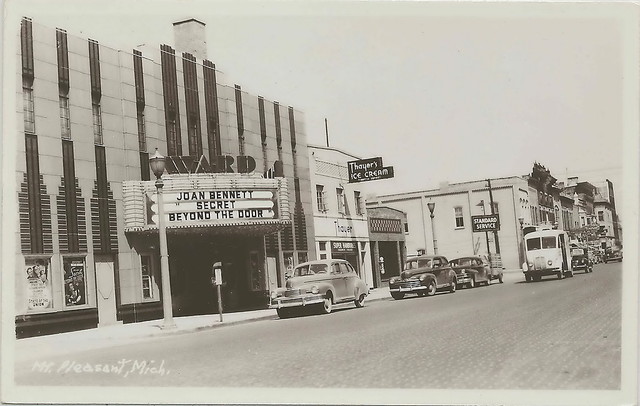
Three: The Cotton Club at the Ward Cinema in Mt. Pleasant, Michigan
My friend, Andy, and I took in this movie, I think at least two times (for me, four or five times at least), in January the year it came out (or the following year, as it probably opened in New York and LA in December to qualify for the Oscars it would never receive). I remember us fidgeting excitedly by the radio, hoping, hoping, hoping that school would be called off from the prodigious snow falling one weeknight, and if it was, we’d go see the movie. Victory! When the word came down that there was no school, we raced to see Coppola’s Cotton Club at the beautiful Ward Theater, a delightful old movie house just a few blocks from both of our homes. God damn I loved that movie! It introduced me to Cab Calloway and especially Duke Ellington, now one of my favorite composers–I listen to his music at least once a month, every month. We would do a little Cotton Club shuffle on the ice outside of the movie afterwards, trying and failing to tap dance like Gregory Hines, and god damn I just wanted to live in New York City and not this shitty little Republican town that held no promise for a clunk like me. The snow and the cold and the two of us digging Hines and Lonette McKee and the mind-blowing Cotton Club, so amazing.
The Cotton Club is an awful, awful movie, so bad that when they re-released it in 2019, I went to see it at the Uptown and walked out. I mean, it is awful. However, all those years ago, whan I saw that black winter sky and the snow descending above the neon of the Ward marquee, “The Cotton Club Stomp” in my head, I knew there would be more than the just the everyday violence of high school in my life. This was my own private “It Gets Better” moment, and I’m grateful for it.
Four: The Empire Strikes Back at the cineplex near the Hampton Mall in Bay City, Michigan
My friend, Keith Harris, a great critic at Racket, wrote of The Souvenir 2: Now More Pretentious, that he couldn’t think of a sequel he was anticipating more in his life. And that made me think of The Empire Strikes Back, which I saw at the cineplex near where my Dad and stepmom, Pam, lived in Bay City, Michigan. I could’ve put seeing Star Wars at the Quad Theater in Saginaw in 1977 on this list, because that was certainly a big moment in my life (though now I wish it weren’t), but I liked, and continue to like, Empire more (I don’t need to ever see it again, though). In my fifty-four years I have never anticipated a film more than Empire and definitely not had such sky-high expectations met… and exceeded. Exceeded by the distance the Millennium Falcon could travel in two hours. My poor Dad! He didn’t like Star Wars, but couldn’t bat away my brother and I demanding to see Empire, which had opened on this particular weekend when we were with him (my folks were divorced). Sigh, OK, kids, we’ll go. Fucking hell! The AT-AT walkers, the frozen Han, the cliffhangers, the ice planet, etc., etc., etc. the nth degree. I still get chills thinking of how I felt as we drove away from the theater afterwards, the long drive back to Mom’s house in Mt. Pleasant, John and I blabbering on about it, and my eagerness to get to Fancher Elementary on Monday to talk it over with all the other kids who’d seen it.
Five (and Six?): Blue Velvet at the Lansing Mall Cineplex and Eraserhead with Kurt at his house
My friend, Andy, was in his first year at Michigan State University, I was still in Mt. Pleasant going to a humdrum community college but readying to hit MSU soon. Lansing was a big enough town to get Blue Velvet at exactly one theater. I had been reading about it in the Sunday New York Times, and watched Ebert poop himself hating on it, and desperately wanted to see this dangerous flick. I had no good ideas about David Lynch then–this was 1986, I’d seen The Elephant Man and Dune. Why would I have seen Eraserhead? Where would I have seen Eraserhead? So, on my recommendation, Andy and I went to see Blue Velvet, us and maybe five other people. Christ, this is one of those movie moments I’ll remember forever. I was hooked by the undulating blue drapes, Angelo Badalamenti’s score, the weird fake jazz as we’re introduced to Lumberton, the ear in the field, everything. I had to wait forever to watch it again, as I was in Mt. Pleasant, it never came there and left Lansing immediately. It was another few months before it arrived on VHS. And then I just wanted to hunt down everything Lynch had done.
Big mistake: with my other best friend Kurt, who also lived in Mt. Pleasant, was a victim of my cinematic urges. The next summer we rented a VHS tape of Eraserhead back in Mt. Pleasant (I think Blue Velvet made stores get Eraserhead, where it was shelved in the horror section). Now, I had seen Eraserhead just a month earlier with Andy when he was home, and while he thought it was good, I loved it. Kurt should experience it! So, one sunny afternoon, we watched it. And when it was over…
Me: “What did you think?”
Kurt (visibly angry like I’d never seen before): “Why… why did you show this to me?”
Me: “Why? It’s amazing, it’s…”
Kurt: “I honestly want to hit you right now.”
Me: “What?”
Kurt: “You need to leave.”
And so I did. His anger subsided by the next day, but I do think he considers that the most offensive film he’s ever seen. That was first time I’d really seen a movie provoke someone to the extent it did Kurt, and it made me want watch everything Lynch has ever done, which I have.
Six: Skid Row at the Trylon microcinema. Still the greatest weekend at the Trylon, in my opinion.
Seven: Sherlock Jr. at the Trylon microcinema for our opening weekend
A brilliant convergence of momentous events: the opening of this amazing little cinema that I’d helped, in my own very small way, become alive and my first viewing of a great film by one of my favorite filmmakers, accompanied by my favorite silent movie band, Dreamland Faces. The Trylon, Buster, Dreamland Faces. I still shudder thinking about it, and I wish I could capture that feeling of sitting in those rickety seats for the first time, watching Buster Keaton for the first time (Janice and I went and watched every single thing of his over the next two weeks), and hearing Dreamland for the first time. Also, I got my first experience with crazy regulars for the first time, when one lovely kook turned to me as we waited for the film to start and shouted, “say, BOSS, what can you tell me about BUSTER KEATON?”
My Dad had passed just a year earlier, and I was still so full of pain and joy, just wishing he could have been there to see this little cinema and experience this moment. I’m not one to believe that he was “looking down on me then”–in fact, I do not believe that at all–but I do think that, had he lived, he would have been overjoyed by this experience.
Eight: The Manchurian Candidate at the Odeon Cinema in Lansing in ’87 or ’88
I couldn’t believe that a mainstream movie this good, from the early 60s, had been lost to time. It’s Hollywood! A major studio! Frank Fucking Sinatra! How could this be? How had this one been lost to us until now (late ’80s)? This one sent me on a lifetime of hunting down “lost” cinema wherever I could find it, because that movie was mind-blowing, especially on the big screen.
Nine: Mr. Bean’s Holiday at the Centennial Lakes Cinema on a rainy Saturday morning
I joke about Mr. Bean’s Holiday all the time with people, but I do genuinely enjoy this movie. I used to do back-up movie reviews at the Star-Tribune, the voice of white suburbanites, and my assignments were typically shitty kids’ movies that the main critic didn’t want to watch. The press screening for Mr. Bean’s Holiday was a rainy Saturday morning, and I could bring people, so I took the neighbor’s two boys (10 and 12, I think) and we all had a tremendously jolly time. I mean, it was a serious surprise, because I hate Mr. Bean and couldn’t fathom I would like this. In fact, I knew I was going to hate it. But it’s a pretty sly critique of British boors and pretentious American filmmakers, and by far the best parody of the Cannes film festival ever made. It’s also gorgeous in spots, the French countryside stunning.
And this: when my Dad was dying of cancer, I recommended this movie to him, and he called me as soon as it was over. “I just got done watching this movie. Twice. I loved it. I loved it because it made me happy because it’s about being happy.” He was right.
Ten: “Static”, a short film by D.H. Johnson, starring Peter Schilling Sr.
My friend, D.H., sent me this file after my Dad passed away. It came at the right time. Dad’s the laughing, smoking man in the trenchcoat. I remember sitting in our old home a year after he was gone and just so surprised to see this. It was good to feel sad again that afternoon, and also laugh. You can see D.H. in the great short film, “Flat Love”.
Eleven: Introducing The Night of the Hunter at the James River Film Festival, at Virginia Commonwealth University’s Grace Street Theater.
I met James Parrish at my Dad’s wake, and we hit it off immediately. He had me out to the James River Film Festival (river’s not named for him) a few times (he programmed and ran the festival), and on one of those instances I got to introduce The Night of Hunter. Now, Night is one of my favorite novels turned into a film–that devastating book just killed me. It inspired me to start a book club about movies (That Movie Was a Book? Club) and every time I’ve convinced people to read the thing, they haven’t regretted it. I got to introduce Night at the festival and insisted the local bookstore carry copies of the novel at the screening. They were hesitant, since it was essentially on-demand publishing, meaning that if they didn’t sell the copies they’d ordered, they were stuck with them (no returns). They ordered six. I complained. Six it was.
I read from the book, a bit nervously (thinking people probably just wanted to see the movie), but afterwards was surrounded by about a dozen or more people asking me about Davis Grubb’s brilliant novel. Heartfelt questions and I can tell you everyone one of them tried to buy The Night of the Hunter–there were a number of disappointed people who didn’t get copies (“the library has it I’m sure!”) The book meant a lot to me, being about a kid who’d lost his father far too young, and the grief and madness that accompanied those feelings, not to mention the deep, deep trouble the hero and his sister got into. And I couldn’t believe that I’d conveyed this to people. The next year a lot of people came to me and remembered the intro and said thanks for recommending the book. That’s… awesome.
Twelve: Sold-out opening night of The Full Monty at the Uptown Cinema next to a good dozen dressed up women absolutely screaming “TAKE IT OFF!” My favorite moment at a great local theater now gone.
Thirteen: Prelude to a Kiss, the first romantic film Janice and I saw together, at the Meridian Mall Cineplex. (This movie sure doesn’t hold up.)
Fourteen: Frenzy, the greatest Hitchcock film about London, on Janice’s and my first trip to London, at the Prince Charles Cinema, on pink 35mm, which is perfect for that grubby, violent flick.
Fifteen: Watching 20,000 Leagues Under the Sea at my Grandma’s house on TV in 1977.
The first old movie I remember seeing that totally blew me away, and, having become a fan of the bad guy, Darth Vader, in Star Wars, I was now totally onboard with rooting for James Mason’s morally complicated Captain Nemo. Man, I loved that sub, the Nautilus. And I loved watching movies and TV shows at Grandma’s, in her dark, wood-paneled living room, her and Grandpa smoking up a storm, eating delicious food, snacks, their old Curtis Mathis set, what a blast.
Also: Visiting Disneyland in Los Angeles in 1978, I was bitterly disappointed in the Nautilus ride, which dropped like eight feet into a pond where you could still see tourists bumbling about at the water’s edge. What the hell was this? I was so infuriated. My mom was right: “Did you really think you’d go out to the ocean?” I did, I truly did. I guess I also hoped we’d tear apart a big wooden ship and watch unfortunate sailors drown, and maybe electrocute a giant squid. Too often my imagination gets the better of me.
This movie, along with the book The Little Prince, was one of the first pieces of media to really make me think, to ponder good vs. evil, life and death. I turned this film over in my head for weeks afterwards. I mean, I didn’t go to the library and check out a bunch of philosophy, but I do remember being totally disinterested in Kirk Douglas and his dumb songs and braying seal and vastly more interested in Nemo’s turtlenecked hero, who is, essentially, a terrorist working for world peace. It probably helped that my Dad and stepmom, Pam, were fighting to stop a nuclear power plant from being built nearby and were big into anti-war stuff at the time.
Sixteen: Cluny Brown
Seventeen: Chinatown at the Heights Theater in 2017
If I was forced to conjure up a top ten list, Chinatown would certainly be on it. I’ve seen this in numerous theaters, at the Parkway when Take-Up Productions screened it, at the Trylon during their Jack Nicholson Experience series, a long time ago in a classroom at Michigan State University, and with my Dad a few times because he, too, loved this flick. I watch it fairly regularly at home, read about it, write about it, and it’s one of the few movies I watch frequently that completely shifts in tone and meaning with every viewing.
I’m not certain what was going on with me in 2017 when Tom (owner of the Heights) screened this film one spring. It drew only moderately well. As the film started, though, I had a shift in perspective. The first time Faye Dunaway’s Evelyn Mulwray enters the film, I decided to see Chinatown from her perspective. I can tell you that’s a totally new way to see it.
As you may know, the story opens with Jack Nicholson’s Jake Gittes being hired by a woman pretending to be Evelyn Mulwray. She wants him to follow her husband, Hollis, whom she believes is having an affair. He’s the chief engineer of Los Angeles’ Department of Water and Power. Gittes & Co. see the man cavorting about with a young, young woman. Gittes files a report which gets leaked to the papers, who report a love scandal involving one of L.A.’s most prominent man.
Bad news: that wasn’t Evelyn who hired Gittes, but another woman, and the real Evelyn, the real wife of Hollis Mulwray, is mad. She wants to sue, and plans to do so.
Spoilers: the girl was not having an affair with Hollis. Hollis is her stepfather, Evelyn is her mother, and the biological father is Evelyn’s own father, the terrible Noah Cross, the most powerful man in Los Angeles. And that means he’s dangerous. It means that he is arguably one of the most dangerous men in their world. Cross planted the fake Evelyn in the hopes of discovering where the daughter is, because he wants to take her for himself. Why, because he loves her or wants her as he wanted Evelyn?
If you switch perspectives, you begin to see how desperately sad the story of Evelyn Mulwray is. From the first moment, she is doing every damned thing possible to protect her daughter, and that means keeping Jake Gittes out of the picture, because he is going to ruin everything. He’s determined to solve the mystery, especially after Hollis is murdered. A former cop, Gittes is hard-boiled, able to take a punch, ready to take on the world to save this woman. Like Raymond Chandler’s Philip Marlowe, from whom his character is obviously inspired, he’s a knight in a sharp suit.
Evelyn, an intelligent and fierce woman with a vulnerable child, knows he is totally full of shit. She knows that he doesn’t even remotely fathom the danger he’s putting them all in. Look at him there, bragging to her about his past exploits, being a tough guy. Look at her, after sleeping with Jake, shrinking away and pulling the sheets around her like a child with a security blanket when Jake casually mentions he met her father, Noah Cross, as if that was a brave thing for him to do. Look at her when she nearly rolls her eyes when Jake, dumb Jake, finally puts one and one together to see that Noah raped her and Evelyn’s daughter is the product of incest. This, of course, after his repeated slapping of her.
There’s a scene that I never paid close attention to before, where Jake brags about his past to Evelyn, reminiscing about the time he worked as a police detective in Chinatown. Back then he tried to get involved with a woman, to save her from some evil there, and his involvement resulted in her death. He chuckles recalling his captain warning him to “do as little as possible” and to stay out of these messes, because usually these troubles are bigger than he is, and meddling will only make things worse. But he failed to heed that advice–he admits that that woman died because of him. He seems untroubled by it, ready to redeem himself here.
My empathy for Evelyn and her daughter reached a fever pitch as the film came to its awful conclusion. Much is made of the great closing line, “forget it, Jake, it’s Chinatown.” But, to my mind, there’s a better line. Jake, stunned at the sight of Evelyn, shot through the head by police, her daughter screaming and taken away by Noah, mumbles to himself, “as little as possible.” History, at least for Jake, repeats itself.
You can barely hear that line–in fact, I’d never heard it before then, not once, and I’ve seen Chinatown a lot. But that line is what causes his former partner in the LAPD, Lou Escobar, to shout, “What did you say?” He worked Chinatown, too, he knows that mantra, too, probably failed to follow that advice himself. He orders Jake away, and then the famous line–“Forget it, Jake”–is stated. This screening left me utterly devastated, and all I could think of was Evelyn–modeled after Polanski’s mother, by the way–desperate to protect her daughter, watching Noah close in on her, watching her every plan fall apart because this damned macho fool Gettes couldn’t stop involving himself, couldn’t believe he wasn’t in control. This shifting perspective is why I watch Chinatown whenever it screens, and will probably always do so.
Jack speaks the line at the 1:46 minute mark.
 Movies with People Watching Movies