
We take a break from our regularly scheduled programme to bring you this special holiday message:
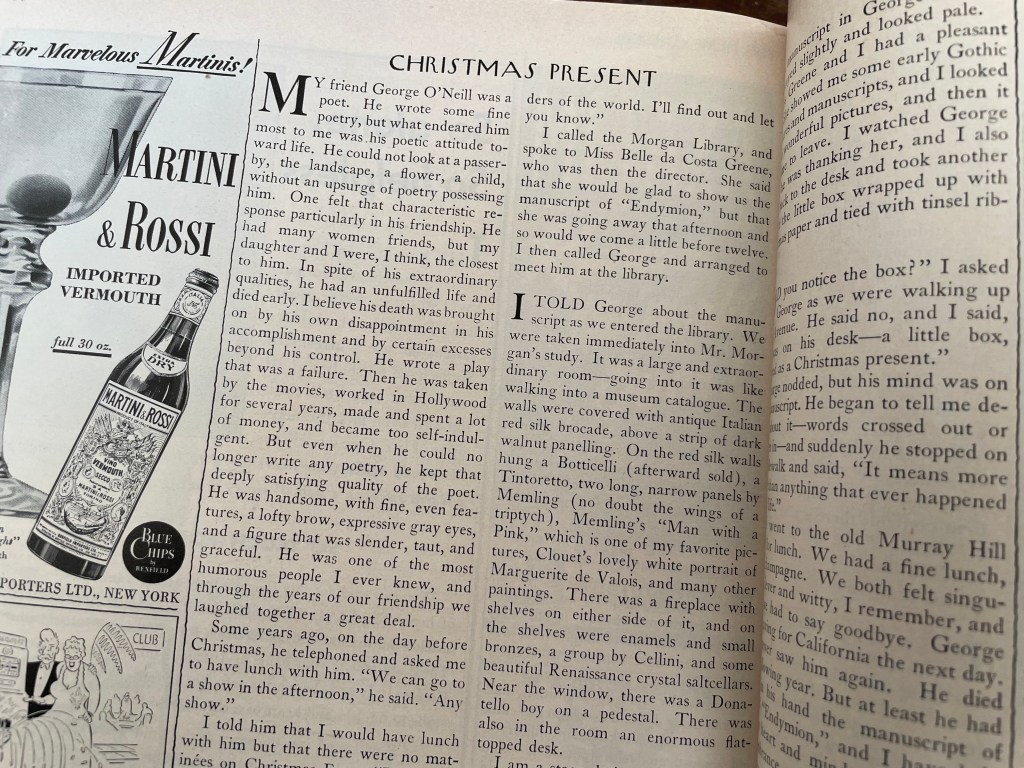
I have recently purchased a library-bound November and December 1951 New Yarker, and have been treasuring its strange advertisements and, frankly, overlong stories for the past few weeks. Because the articles haven’t been all that great, I was stunned to come upon Aline Bernstein‘s reminiscence, “Christmas Present”, in the December 22 issue. This short, slight, paradoxically heartwarming and heartbreaking memory floored me as I read it over coffee. It celebrates all that I love about the season: friendship, curiosity, the pleasure of afternoon excursions, art and its mysteries, of feeling “singularly clever and witty” with another person over lunch, all of this wrapped up in a lovely little package.
Aline Bernstein was a celebrated set and costume designer in the first half of the 20th Century. As she notes, her friend George O’Neill (it’s actually O’Neil, one ‘l’, and I’m not sure why she added the second), was known, perhaps, for the scripts to the American remake of Intermezzo and the first Magnificent Obsession (the remake, by Douglas Sirk, is better known). He died in obscurity–I can’t even find an obituary.
I’ve re-typed this story for everyone to enjoy, because our friends at the New Yarker don’t make their archives available unless you shell out for a subscription, which seems to go against what the holiday season means to me. Maybe they’ll demand I take it down eventually. I hope you enjoy it for a little while anyway. I’m going to read “Endymion” today, though I doubt I’ll understand it. I will also give thought to what object I would seek out that would give me as much profound joy as that manuscript gave George.
Happy holidays to all my family, friends, and those I have encountered with joy.
CHRISTMAS PRESENT by Aline Bernstein
My friend George O’Neill was a poet. He wrote some fine poetry, but what endeared him to me was his poetic attitude toward life. He could not look at a passer-by, the landscape, a flower, a child, without an upsurge of poetry possessing him. One felt that characteristic response particularly in his friendship. He had many women friends, but my daughter and I were, I think, the closest to him. In spite of his extraordinary qualities, he had an unfulfilled life and died early. I believe his death was brought on by his own disappointment in his accomplishments and by certain excesses beyond his control. He wrote a play that was a failure. Then he was taken by the movies, worked in Hollywood for several years, made and spent a lot of money, and became too self-indulgent. But even when he could no longer write any poetry, he kept that deeply satisfying quality of the poet. He was handsome, with fine, even features, a lofty brow, expressive gray eyes, and a figure that was slender, taut, and graceful. He was one of the most humorous people I ever knew, and through the years of our friendship we laughed together a great deal.
Some years ago, on the day before Christmas, he telephoned me and asked me to have lunch with him. “We can go to a show in the afternoon,” he said. “Any show.”
I told him I would have lunch with him but that there were no matinees on Christmas Eve. “Isn’t there something else you’d like to do after lunch?” I asked.
“No,” he said. And then, “Yes, there is something—don’t think I’m crazy when I tell you. I’d like to look at the manuscript of Keats’ ‘Endymion.’ I’d like to hold it in my hand just once before I die. And I still don’t even know where it is, or if it still exists.”
He had written a book about Keats, and a plaster copy of the death mask of Keats hung in his bedroom. I believe that he identified himself with Keats the way Elinor Wylie identified herself with Shelley. He ought, in any case, to have known that the manuscript of “Endymion” was in the private library of the younger J. P. Morgan, who had inherited it from his father, but he didn’t know this and I was enchanted that he didn’t. I said, “Why don’t I see if the Morgan Library is open today? We could go there and see some of the wonders of the world. I’ll find out and let you know.”
I called the Morgan Library, and spoke to Miss Belle da Costa Greene, who was then the director. She said that she would be glad to show us the manuscript of “Endymion,” but that she was going away that afternoon and so would we come a little before twelve. I then called George and arranged to meet him at the library.
I told George about the manuscript as we entered the library. We were taken immediately into Mr. Morgan’s study. It was a large and extraordinary room—going into it was like walking into a museum catalogue. The walls were covered with antique Italian red silk brocade, above a strip of dark walnut panelling. On the red silk walls hung a Botticelli (afterword sold), a Tintoretto, two long, narrow panels by Memling (no doubt the wings of a triptych), Memling’s “Man with a Pink,” which is one of my favorite pictures, Clouet’s lovely white portrait of Marguerite de Valois, and many other paintings. There was a fireplace with shelves on either side of it, and on the shelves were enamels and small bronzes, a group by Cellini, and some beautiful Renaissance crystal saltcellars. Near the window, there was a Donatello boy on a pedestal. There was also in the room an enormous flat-topped desk.
I am a stage designer, and it is part of my business to look at everything. For all I knew, I might someday have to design a play that was supposed to take place in this very room. So I took a good look at Mr. Morgan’s desk. It was all fitted out with a huge blotting pad, pens, and so on. What I particularly noticed, however, was a little box wrapped with Christmas paper and tied with tinsel ribbon. On the box there was a card, held in place by the ribbon, and a spray of holly. Written on the card, in an uncertain hand, were the words “Merry Christmas, Mr. Morgan.” I thought, Now what on God’s earth would anybody give J. P. Morgan for Christmas? It was ridiculous, considering all that he had—even considering just what he had in this room. I stood there smiling to myself for a moment, and then Miss Greene came in. She took out various things to show us—I remember there were some early Celtic manuscripts—and then she put the Keats manuscript in George’s hands. He swayed slightly and looked pale.
Miss Green and I had a pleasant talk. She showed me some early Gothic sculptures and manuscripts, and I looked at the wonderful pictures, and then it was time to leave. I watched George while he was thanking her, and I also went back to the desk and took another look at the little box wrapped up with Christmas paper and tied with tinsel ribbon.
“Did you notice the box?” I asked George as we were walking up Park Avenue. He said no, and I said, “It was on his desk—a little box, wrapped as a Christmas present.”
George nodded, but his mind was on the manuscript. He began to tell me details about it—words crossed out or written in—and suddenly he stopped on the sidewalk and said, “It means more to me than anything that ever happened in my life.”
We went to the old Murray Hill Hotel for lunch. We had a fine lunch, with champagne. We both felt singularly clever and witty, I remember, and then we had to say goodbye. George was leaving for California the next day.
I never saw him again. He died the following year. But at least he had held in his hand the manuscript of Keats’ “Endymion,” and I have held in my heart and mind ever since the remembrance of that visit to the Morgan Library—of the gratification of George’s soul and the mystery of the little box.
I am sure it came from a child. There was something childish about the writing on the card.
The New Y(o)rker, December 22, 1951
 Movies with People Watching Movies