
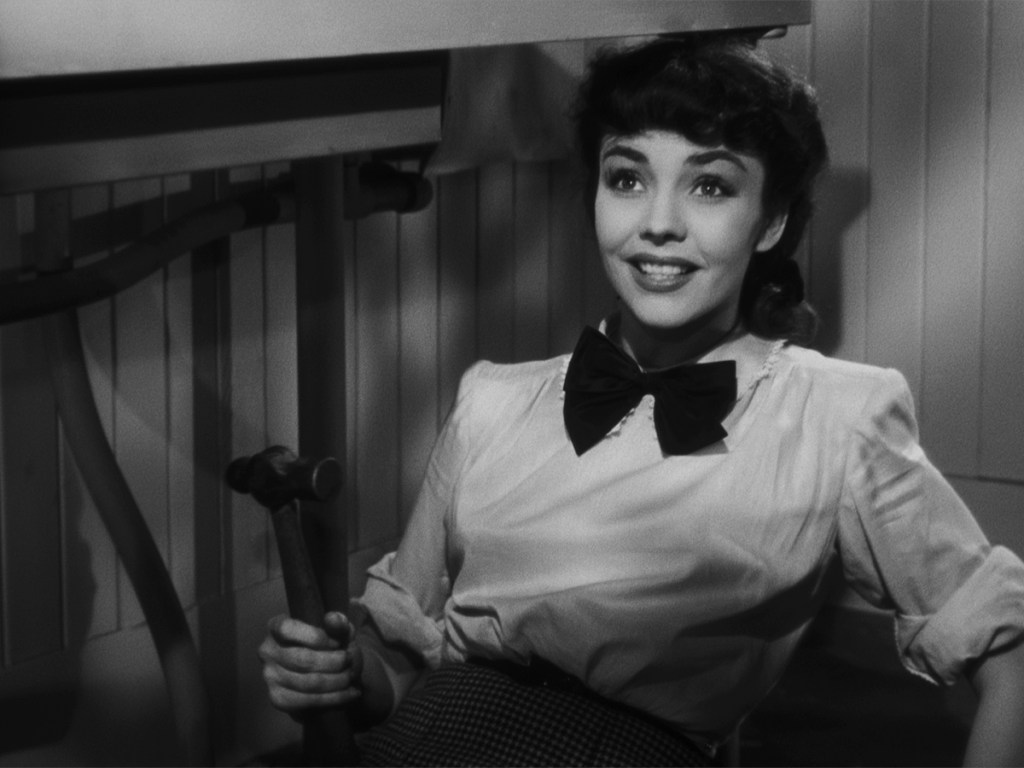
Cluny Brown (1946), dir. Ernst Lubitsch. Blu-ray at home, Friday, December 16.
Whenever there’s talk about favorite movies, my assumption is that the people who discuss “the greatest” mean movies that they’ve been watching, enjoying, or have been influenced by for many years. Pictures they’ve seen again and again. To stretch a point, these films are like a good couple finally getting married: when two people have been in love for some time, and you admire their coupledom, it’s exciting to hear about the forthcoming nuptials and you hope for a wedding invitation (or, at least, I do–I love weddings).
But what about that couple that’s fallen madly, brazenly in love, a swift, passionate romance, bam, Bam, BAM! and they’re getting married. Oh, man, what? You two got married already? How long have you known each other? I mean, yeah, it’s great, but… No matter the age of the lovebirds, we tend to think of the words “reckless” and “rash” and, worse, perhaps, “unwise”, “foolish”, etc. No one should get married that quick.
Well, that’s me and Cluny Brown. I love this ridiculous, flawed movie, I’ve bugged people about it, I watch it again and again and again and would put it on my top ten list for no other reason than “you know what, go to hell, I love this movie!” I first saw it three years ago and I wrap my arm in Cluny’s arm and announce that it’s one of my favorites of all-time. Don’t judge me.
I first saw Cluny Brown in 2019. I’d just endured some very bad movie with Jennifer Jones (who plays the lead), and had heard of the film, but, honestly, I think in the history of my memory I was confusing it with both Putney Swope and Kitty Foyle. Then I was reading about Jones in David Thomson’s Biographical Dictionary of Film, one of my favorite books, which has the briefest mention of the movie, and there I noticed it was directed by Ernst Lubitsch, one of my favorite directors. Cluny Brown was his last movie. So I looked it up and everyone who wrote about it dismissed it as “lesser Lubitsch”, or barely mentioned it, which is the same. Whatever. I’m bored, it’s late, I use the search function on my crap Roku TV, and there’s Cluny Brown, streaming only on one of those shit sites whose name is something like “Classics For You!” and is free. On this channel, Cluny Brown looks as though someone found a homemade VCR tape that was copied from another homemade VCR tape which had been copied from the original VCR tape, which was already a bad transfer. No subtitles available, everything soft and smudgy the way videotapes used to be, except worse.
Well, Cluny Brown threw me to the floor. It was cold outside and I was cozy inside and I laughed and laughed and got caught up in Cluny’s exploits and was surprised and I cried and in the end I was just so happy. Afterwards, I sat in bed thinking about how happy that movie made me, and drifted off to sleep. And what I can’t forget is this: I actually woke up happy from Cluny Brown.
Since I couldn’t stop thinking of the movie, I went online to look for a DVD and saw, oh, holy cow, a Criterion disc was released that summer or fall prior. I ordered the Blu-ray from Criterion. When the Blu-ray arrived I watched it again, in perfect clarity. And I laughed again and cried again and was so damned charmed once again and I will tell you that again the next morning felt sunny thanks to this lovely movie. To the annoyance of my friends Tom and Dan at movie night, I forced it on them. I forced it on Janice (that made four viewings in three or four months). I bought it as a gift for a friend and convinced another friend, Daniel, to watch it (he’s the one guy who actually agreed with me and flipped just the same). After all that, I watched it one more time and put it away.
Until the spring of the next year, when I watched it again. And then the following spring. And then just the other night, for the first time in too long it seemed. Often I will connect a movie to the time of year when I first watched it, for instance loving Amadeus over the holidays or Chinatown in the summer or Jane Austen movies in the fall. No way with Cluny. I watch this creature whenever the mood strikes me. And the mood strikes me all the time. Writing about it now, I almost feel like going home and watching it again.
Like a sudden spouse, you see their faults but the rush of love is so great you just don’t care. Cluny Brown is a preposterous tale of freedom, coincidences, the inhibited and the uninhibited, sex (absolutely about sex), the English class system and the perils of Nazi Germany, squirrels to the nuts, and ultimately, love–love borne from experience and love that is innocent, both colliding against cruel systems that seek to keep people “in their place”, which is really a system meant to deny love. It is an Ernst Lubitsch film so that means it is hilarious, that means it is well cast, and that means that it has moments of such startling emotional power that you pause, stunned that such a moment has occurred in a comedy.
Cluny Brown is all of this, and it is also one of the great films about plumbing. It opens with a fool named Hilary Ames (Reginald Gardiner) who is on the phone, trying to get someone to unclog his very clogged sink. I mean, the sink is full of water up to the brim with what appears to be the contents of a full-on salad floating around. He’s about to have a party, and has to get his sink unclogged.
Suddenly, the doorbell. The plumber! Not so fast–enter one Professor Adam Belinski (Charles Boyer). He is not the plumber, but a refugee, a professor who has made a career out of attacking the Nazis, and now he’s on the run in London, as his own country, Czechoslovakia, is overrun by the German army (Cluny Brown is from 1946, so this was all very fresh in everyone’s mind). He’s at this apartment to cadge a few pounds and crash on the couch of the man who owns the apartment, but who, it turns out, is traveling. That man has subleased it to the foolish Ames. Shortly after the professor’s arrival, there’s another ring of the doorbell, and in comes Cluny (Jones). She’s young–I think she’s supposed to be like 18 or 20 or, at most, 22. And she sniffs the air when Ames opens the door. Yep, he’s got a clogged sink, she can smell it. Her Uncle Arn is a plumber, Ames had called him but Cluny answered because her Uncle was out. But she’s here and ready to give it a go. And that’s exactly what she says, in her husky voice: “how about we give it a go?”
Ames is reluctant, for this is just a girl, and attitudes at the time were squarely against women working the pipes, especially young ladies like Cluny. But Belinsky is charmed, he can sense something in her, so he convinces Ames to let her try. Loping into the kitchen past the two stunned men, young, sexy Cluny rolls up her sleeves and rolls down her stockings and folds herself beneath the sink, all the while talking about how she loves tea at the Ritz and how her Uncle Arn keeps trying to put her “in her place”. She doesn’t know where her place is, exactly. So Belinsky, who is running from a country that has been put in its place by the Nazis, pursues this:
Belinski: That’s very interesting. You don’t seem to be inhibited. Tell to me more specific – what made you think you were out of place?
Cluny: Oh, I don’t think I was. It’s Uncle Arn. He’s always telling me, “Cluny Brown, you don’t know your place.”
Belinski: Nobody can tell you where your place is! Where is my place? Where is everybody’s place? I’ll tell you where it is. Wherever you’re happy–that’s your place. And happiness is a matter of purely personal adjustment to your environment. You’re the sole judge. In Hyde Park, for instance, some people like to feed nuts to the squirrels. But if it makes you happy to feed squirrels to the nuts, who am I to say, “nuts to the squirrels?”
That’s a key line: “Wherever you’re happy–that’s your place. And happiness is a matter of purely personal adjustment to your environment.” Though “squirrels to the nuts” is also good.
Well, Cluny fixes the sink, is fixed strong cocktails by the men (her first cocktail, “a dry martini cocktail… with an olive!”), and she unfolds on the sofa and talks about reading the travel section of the newspaper and dreaming of being in a foreign land and fixing plumbing. Then her eyes thin, she extends herself further on that loveseat, and purrs about having a “Persian cat” feeling, presumably helped by the booze. Here we see the true Cluny: she’s passionate, she’s happy, and she’s truly uninhibited–she has feelings and, unlike most people (though especially the British), she likes to explore them, see where they go.
Well, Uncle Arn arrives and, seeing her in this manner, is infuriated. So he hauls her away, we’ll never see her again, and everyone will go their merry way in life, right?
Not a chance, thank God. In one part of London, there’s Ames’ dull party (the one saved by Cluny’s plumbing prowess) where now Professor Belinsky, who apparently has been invited to attend, is taking a nap, avoiding the upper crust that bore him so. In another part of London, Cluny is weeping as she packs her suitcase, as her Uncle Arn, desperate to get this untamed girl “into her place”, has set her up as a domestic at a rural estate. Back at Ames’ party, a young dope named Andrew Carmel (Peter Lawford), a man who considers himself a tremendous anti-Nazi patriot because he’s written letters to conservative newspapers, discovers our hero napping, recognizes him as the professor who has been a true enemy of fascism, and helps the rootless man by sending Belinsky to his parents’ estate in the country. Which is the same estate where Cluny has been sent.
Next we see Cluny emerge from a train in a small village, the place where she is to work, and she’s got company. On the trip, Cluny has made fast friends with an old man, called the Colonel, who has a friendly dog that loves the girl, too (the Colonel remarks that the dog doesn’t like many people). We slowly see that Cluny and the Colonel, who is firmly entrenched in the upper class, have been talking the whole way, laughing and enjoying each other’s company. When he hears that she is going to the Carmel estate, he offers her a ride. Problem is, he doesn’t realize that she’s to be a servant there–he would never have spoken to her otherwise, he would have remained “in his place” (and been denied the joy of her company). He escorts her inside the home, where she meets Sir Henry and Lady Carmel. They’re baffled–who is this young woman the Colonel has deposited in their laps? They offer her tea, she gobbles crumpets and dissolves four lumps and rich cream in her tea, and totally charms the Carmels… until she mentions that she thought they were going to starve her, she thought they were going to be terrible people to work for. Now realizing she’s their new servant, they ring a little bell and the butler, Syrette, arrives and stands coldly. The Carmels tell her to finish her tea, try to be friendly, but stand and abruptly leave–the Carmels in their place, Cluny hers. She is left, alone, with only a stone butler glaring at her.
Cluny will be lectured by both Mrs. Maile (the housekeeper and head of the women who work there, played by Sara Allgood) and Syrette (Ernest Cossart). Everyone in this estate is a sad, lonely, inhibited blockhead, Syrette and Mrs. Maile clearly suppressing strong feelings for one another, the Carmels stuffed shirts who probably haven’t expressed a strong feeling since they were children. This is usually funny, but at times, thanks to Lubitsch, it’s actually heartbreaking.
Belinsky arrives, a whirlwind of chaos, of desire, and, actually, of kindness and empathy. He likes to engage his hosts, toasts England by quoting Shakespeare to them (they have no idea what he’s talking about), and, when told that Syrette will be his valet, makes a lovely speech about how his one suit, his only suit of clothes, will feel proud to have such attention. Then he sees Cluny, and, saddened at her sudden misfortune, plots to free her from the clutches of unhappiness.
I believe it was critic Molly Haskell, in a small video on the Criterion disc, who noted that Cluny is unknowingly uninhibited, while Belinsky is knowingly uninhibited, and this is a wonderful pair to thrust into the face of the British class system. Belinsky is perfectly capable of adjusting to his environment and being happy; Cluny would be, but she’s young and a woman, so there’s a lot of pressure put on her, pressure she happily resists until it clamps down hard. Sadly, this movie is, in a way, the story of a young woman who loves life but runs headlong into systems that seek to destroy this love, in the guise of order.
Belinsky has seen enough of this order in the war that has engulfed his country. Cluny Brown is a very bizarre film, because in many ways it’s haphazardly made–it took me three viewings to understand Belinsky, and everyone I’ve shown it to is baffled by his character. Each time, we’ve had to pause the picture for them to try and grasp Belinsky, and it’s only because of my repeated viewings do I think I have answers. At first, it seems as though he is a man playing Belinsky, an impostor, but after repeated viewings I see that he is who he is, which is a man on the run, but also on the make, trying to be happy. In every instance, he’s seeking out happiness, and at times that makes him weird, because sometimes this is in the guise of a free meal, a few pounds, a place to take a nap, or, later, maybe even a quick shag with a woman named Betty Cream (who loathes him). And, coming from Czechoslovakia, now under the thumb of fascism, he’s shocked to see the British class system oppressing people. They don’t know their own histories, they don’t know the threat that faces them in Germany, and look at this woman Cluny! They clearly don’t know what to do with such a lovely, free-spirited person. Belinsky is a trickster god whose job is to shake up these idiots and make them understand that life is to be lived, especially if you live in a free world. And, specifically, his job is to help Cluny.
What makes Cluny Brown stand out is its total commitment to Cluny and her uninhibited, unconditional love. When her Uncle is sending her away, she is genuinely distraught–this is our first taste of the intense emotions of this movie–and reasons with him that he will be lonely without her. Uncle Arn is a caricature of a grumpy, upstanding old Brit… until he gives her a gift, which is a picture of himself, which makes Cluny cry. Honestly, it made me tear up, it was such a surprise moment of genuine feeling.
Later, Cluny will fall in love. The man is a local chemist, Jonathan Wilson (Richard Haydn), who wooed Cluny when she picked up medicine for Mrs. Maile. Now, Jonathan is the perfect flop who is meant to be thrown over. Every screwball comedy has the passive hero fall for a milquetoast like Jonathan, so that the more active hero can swoop in to shove this dullard aside so that the real loving can start. Cary Grant’s fiancee Alice Swallow in Bringing Up Baby (shoved away by Kate Hepburn) or Rosalind Russell’s fiancee Bruce Baldwin in His Girl Friday (shoved away by Grant) to name but two. We don’t care about these creeps, their desires are oppressively conservative, they’re almost repulsively asexual, they say silly things and the thought of the love interest married to them is frightening and makes you root for the lunatic lover to steal them away. That’s part of the formula, and it’s fun and it’s effective.
The uptight Jonathan has her over for tea and he is a stuffed shirt if ever there was one. But, he’s also kind of fascinating. He is confident, he is set in his ways, and he also is a man who has lived in his village his whole life, with his coughing mother (Una O’Connor, who never speaks but just clears her throat). He’s set up a chemist’s shop and is even a volunteer fireman. He proudly shows Cluny a map of the area, with a pin to show where he was born and raised, and another pin to show where he is now. He has a little organ and plays her dull music. We could laugh at all of this, at his pride of home and his bragging and his self-important ideas, and do. Then this scene begins to complicate, because Cluny is enthralled. She is genuinely overjoyed by his words. She asks, breathlessly, about his life and almost swoons when he tells her, and she reveals that she can imagine him saving people from a fire, which thrills both of them. Never, in any of the screwballs I’ve seen (and I’ve seen almost all of them), does the hero display such passion for this type of character.
This is no act. Later, when speaking of this annoying man to Belinsky, he is stunned. Cluny truly loves this arrogant chemist, and explains why: she’s never had a home, she’s an orphan and, she notes, when you’re an orphan having a home is a true dream. It is at this point that you start to realize that Cluny’s passion and crackling intelligence have concealed a hungry heart. Cluny wants love, she wants to give love, and she has a very clear vision of a happy family, and it includes being a wife and raising children in the back of this chemist’s shop. Yes, she wants sex (that’s apparent every time she speaks of plumbing), but mostly she wants to dote on someone and be doted on, and she senses that her own enthusiasm can bring that to a marriage, can bring love to anyone. Even this fool and his coughing mother.
But the system of proper places interferes, this terrible and very British sense of fitting in and being slapped down, hard, if you try to squeeze past the narrow confines. Cluny is hurt, and hurt very badly, by Jonathan in a scene that veers between hilarity and tragedy in just a few seconds. What we fear is that Cluny will have her wings clipped, have her life destroyed, not physically, but spiritually. And in that scene, almost nauseating in its cruelty, we sense that Cluny is about to become a caged bird. The first time I saw this movie I was so scared because, even though I knew this was a Lubitch movie, I just couldn’t see how she could be happy after this.
Fear not, this is a Lubitsch film so, like The Shop Around the Corner, we’ll have a happy ending, but boy will it be earned. Despite my fever for this wonderful picture, I can see why people don’t like it, because it is a perplexing experience. Charles Boyer is perfect and Jennifer Jones is perfect but he’s much older than her and that’s weird today, but in the context of the film, he truly is the only one who gets her (also, the very end has them abandoning England for America and yeah, that’s the only country who would get Cluny, even, and maybe especially, during wartime). There’s some very strange subplots and odd characters, but it’s all in the service of love and freedom.
So what we have here is one of the greatest practitioners of screwball (with Howard Hawks ) taking what is usually a battle of the sexes and tossing in a twist–an absolutely earnest character who is both uninhibited (like Hepburn in Baby and Grant in Girl Friday) but who exudes love, genuine, unconditional love, a love that is pure and real and wants only to be expressed with kindness (and, yes, a bit of sex). Cluny Brown in Cluny Brown makes me happy, happy all the way through, happy for a long time, my gosh, even happy just thinking about her now.
 Movies with People Watching Movies