
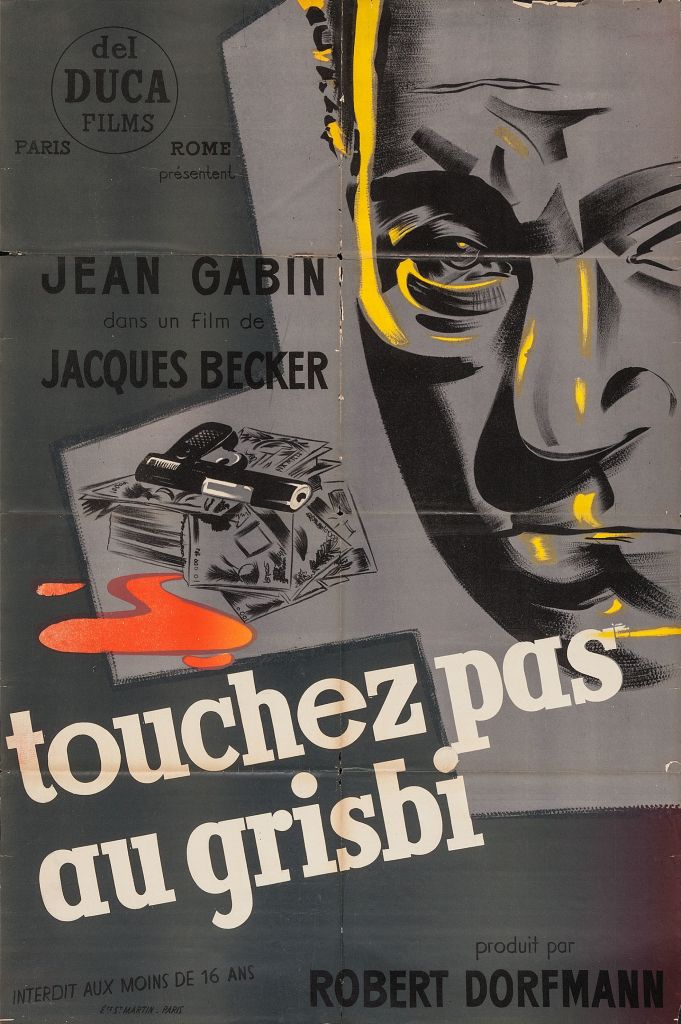
Touchez pas au grisbi (1954), dir. Jacques Becker. Streaming at home, Friday, Decembver 2.
God, what a strange and wonderful little film. I came into this thinking it was a heist film, whose ingredients usually involve a guy with a plan who finds another guy whom he trusts, then together they build of the heist team, then they all planning, which reveals scheming and backstabbing (you know, character), then comes the execution of said plan, then the eventual unraveling, the deaths, the apprehensions. The end.
That’s not Touchez pas au grisibi (which is French for “hands off the loot”). I’m usually loath to quote Roger Ebert, but here he puts it well: “Growing older is a balancing act between skills that have never been better, and abilities that sometimes betray.” This is a movie about two older criminals trying to cope with their superior skills undermined both by their age and a changing world, and the affection that they feel for one another. It’s remarkable.
We open with Max the Liar (an aging Jean Gabin, never better), enjoying dinner at a cafe that caters to the Parisian underworld–so much so that even with empty tables, the proprietor turns away paying customers because they’re not part of the circle of theives. Max is there with his girlfriend, Lola (Dora Doll, what a great name), and, we are soon to discover, his partner and absolute best friend, Henri (René Dary). Across from him is the conniving Josy (Jeanne Moreau), Henri’s showgirl squeeze. Max is reading in the paper about the theft of gold bars from the Orly airport. They enjoy their dinner, and afterwards, Max is disinterested in enjoying the evening further, he’s older, he wants to go home. Henri pushes Max to join them, and so they head to the nightclub where both girls work.
In short order we discover that these two committed this heist. What? The heist is already over?! Like Poe’s “Cask of the Amontillado”, this story exists in the denouement. We also soon learn that Max is sophisticated, he is smart, and he is winding down. Fatigued by fast living, fully embodying Ebert’s notion that his vast skills are now no match for younger, and hungrier, thieves, he hopes to escape this life and retire.
Already we see the problem–Henri. Henri is an idiot. Max also loves him dearly. I was slow to pick up on this, but in the nightclub scene, you see how Max pulls his chair close to his friend, lights his cigarettes and chides him constantly for his idiotic appetites, like young girls and midnight living. This is so apparent one gangster, the nightclub owner, watching the two through a porthole in his office, comments on their 20-year-partnership with admiration.
This relationship is also their greatest vulnerability. One thug, who is also having an affair with Josy, pounces on this knowledge–he and his gang kidnap Henri in exchange for the gold bars. And all hell breaks loose.
But not before a magnificent scene that just floored me. If I had to guess what scene was going to floor me in this crime film, I would have probably thought it was some great moment of tension, a gunfight, the criminals fleeing.
Instead, Max has become aware of the plot, and has fended off attempts at kidnapping him, and his pal. He convinces Henri to come home to a secret apartment Max has stashed away, and parked there in a big car is the loot. Max and Henri trudge upstairs, tired, and while Henri plops down on the couch, Max goes to the kitchen. The whole time he’s lecturing his best friend, about his bad habits, how he needs to get it together, how they’re not getting any younger. There’s a kidnapping attempt at foot, and in a normal film there would be some gotcha moments where we see how formidable this duo can be. Instead, Max opens a bottle of white wine and pours it into two tumblers. He sets down plates and a carton of biscuits and a can of pate. He opens the pate, apologizes that there is no bread, and begins to shovel out two generous portions of the meat spread onto the plates. The men drink. The men eat. They talk. They talk about nothing.
Then Max gets up and begins to make up the couch on which to sleep. He gets into pajamas, brushes his teeth, then gives Henri pajamas (that fit perfectly, of course–Max is a man of details), gives him a toothbrush, and goes to settle in on the couch. Max was going to take the couch! But Henri insists on the couch himself, and the men lay smoking across the room from one another, talking until sleep overtakes them.
That’s a beautiful moment in this sweet and melancholy movie about aging and friendship. It has its action; it has its sexy moments. Since it’s French, its ending is far from upbeat, yet moving. I absolutely loved this picture, and would someday love to create a series of crime films involving older men–this film, Going in Style, The Late Show, there’s more, I can’t think of them right now. This is a pipe dream, of course, as no one would come, nor would anyone put it on, even. But a man can dream, just as Max dreamed of a soft retirement with his best friend and the simple pleasures of old age and companionship.
 Movies with People Watching Movies