
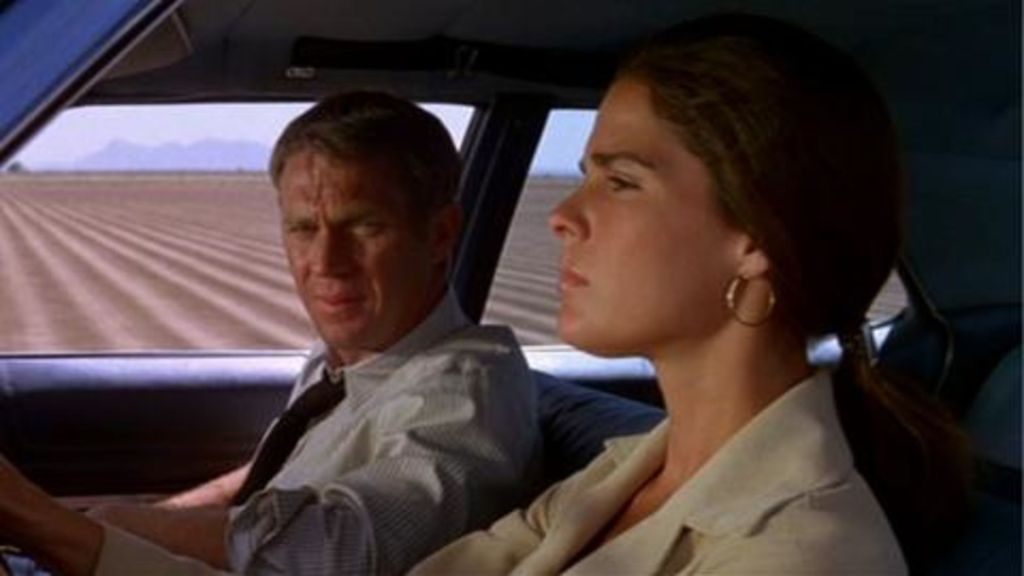
The Getaway (1972), dir. by Sam Peckinpah. Streaming at home, Saturday, November 19.
After reading Quentin Tarantino’s fabulous Cinema Speculation, my reaction to Sam Peckinpah’s The Getaway is very similar to my experience to that of Howard Hawks’ The Big Sleep (1946). When I was in college at Michigan State University, I went to the Curious Book Shop with a little bit of money and bought a second-hand copy of Raymond Chandler’s The Big Sleep. It blew me away. I’ve since read all of Chandler’s stuff, and I reread his novels constantly. Though there are many books that have meant more to me as a human and a writer—The Little Prince, The Plague, The Autobiography of Malcolm X, Up in the Old Hotel, to name a few—if I’m honest, Chandler is probably my favorite writer, whose work I’ll read in part every year until I’m gone.
Chandler’s The Big Sleep is a moody, beautiful novel and Hawks’ The Big Sleep is not moody nor beautiful, at least in a way that stands out. I think few people, even fans of Hawks and that movie in particular, would ever say, “Ah, yes, what a beautiful movie.” The movie is funny and sexy and thrilling. And I hated it when I first saw it. What the fuck is this shit, this isn’t anything like the book!
But then I read David Thomson’s Biographical Dictionary of Film in 2002, most notably the entry on Hawks. There, he notes that The Big Sleep is “really a love story” and that Bogie and Bacall are not only “tangled in a tortuous thriller but a constant audience to the film, commenting on its passage.” Now, suddenly, my eyes were open. That was literally my first really profound experience noting that a movie adapted from a book is always better when the director makes it their own. Hawks wasn’t going to make a moody, beautiful, despairing book like Chandler’s—basically, Chinatown does that perfectly—and his film is radically different and thoroughly enjoyable as a separate thing. In fact, I’m hard pressed to find a movie that hews closely to the source novel that is legitimately brilliant. Now I love both the book and the film, the book more, but the movie is always a delight.
Well, let’s cut to The Getaway. Same exact thing, except this time I’m being schooled by Quentin Tarantino. In his essay on The Getaway, QT notes that there are many people, myself included, who are nuts for Jim Thompson’s novel of the same name, from which the script is based, and in part this is due to the incredibly bizarre ending. The book is thrilling and shocking and brutal, and then its ending takes a twist that is absolutely perfect. Some people hate the ending, but there’s many of us who are nuts for that book because of the ending. That’s me all over.
But when I first saw Peckinpah’s The Getaway, I couldn’t believe it. The movie was toned down, that ending (and other great, brutal bits) was completely removed, and it seemed to be more a film about the love affair between Steve McQueen and Ali McGraw. How dumb is that?
Well, Tarantino notes, is exactly what The Getaway, the film about, that and Sam Peckinpah’s career in film. The Getaway is very self-referential, and seeing it the other night, I saw that it was a dynamite action film, but also about the trappings of fame and what it does to a couple and about the aging director Peckinpah and how he needed a hit. And the “subdued” brutality actually becomes more potent in that context.
My suggestion, then, is to grab Tarantino’s amazing book (it’s really great), read his essay on The Getaway, and then watch The Getaway.
 Movies with People Watching Movies