
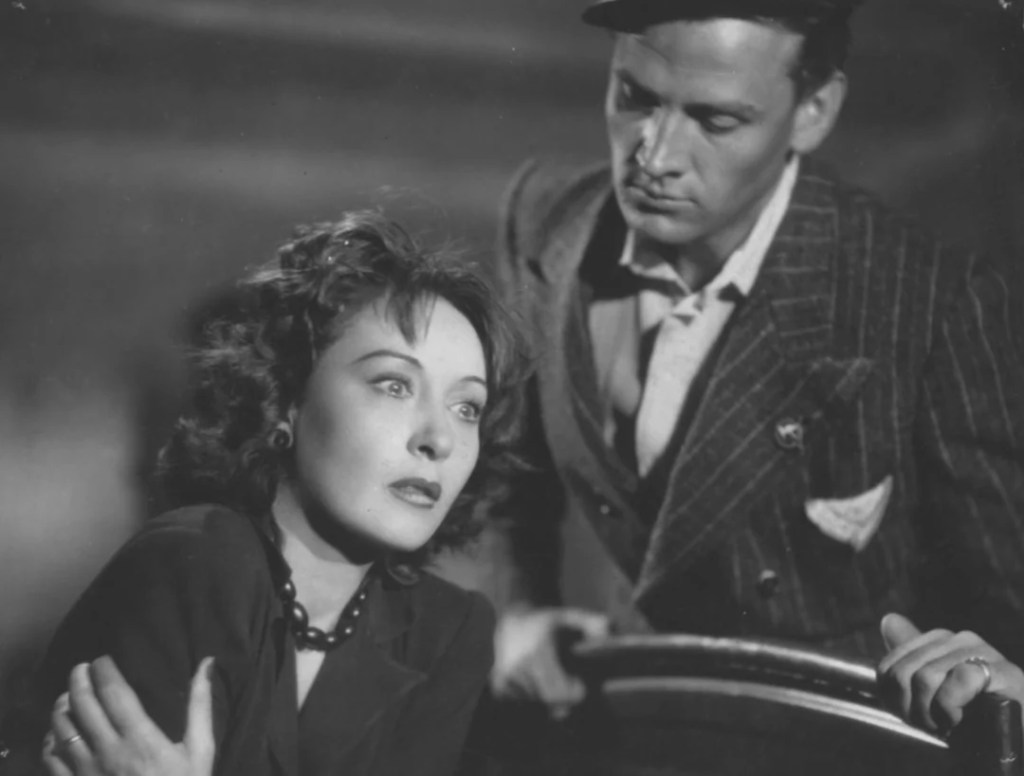
Ossessione, 1943, dir. Luchino Visconti. An ancient DVD from Europe (not available in the US), Tuesday, November 1.
So, right in the middle of World War II, in the last years of Mussolini, Luchino Visconti decided to adapt James M. Cain’s blistering American noir, The Postman Always Rings Twice. Trust me, that novel is brutal by today’s standards, lust and violence and despair, all of this coated in a fatalism so bleak and critical of the American dream it makes you think, “well, maybe I’m a Marxist after all…”
Thing was, Visconti was working from a French translation of the novel, given to him by Renoir, with whom he worked in the 1930s. Visconti’s film, called Ossessione (Obsession in English), is considered by some (and not by others) to be the very first Italian neorealist film. And yes, this is neorealism for sure—squalor writ large on the silver screen. There’s a stunning scene, later in the movie (I’m going to spare you the plot summary except to say it’s about lust and murder and the weight of poverty crushing confused souls), where Giovanna (Clara Calamai), the lead actress, wanders into her kitchen. She owns a restaurant, there was a massive party, and the kitchen is just filthy. There’s dishes stacked higher than her, dozens of melon rinds, pots and pans, a strip of flypaper dotted with corpses, all of this lit harshly from a lamp near the ceiling. The poor woman surveys the wreckage, then goes to a pot on the stove that has steam screaming from beneath a lid, opens it, sniffs it, then ladles herself some thin soup. Carrying the bowl and a ragged newspaper, she pushes aside some dishes, props up the paper against another stack of plates, eats a couple of bites, and then slowly slides across this small corner of the table and slips into an exhausted sleep.
Mussolini banned this movie and the authorities destroyed all the copies save the one negative Visconti held onto. The fascists couldn’t stand the squalor (among many reasons, I’m sure). How its script got past censors is beyond me. Later, after the war, they couldn’t screen it here because—whoops—Visconti never secured the rights to The Postman Always Rings Twice, and by now the Americans have made their own hard-hitting, and very great, version of the novel. And so now if you want to watch it you go to eBay and grab a DVD, whose image alternatively looks as crisp as any Criterion restoration and the next moment smears into looking like the worst VHS transfer. It kills me that this thing simply can’t be seen as it should be, namely, on the big screen. I’d take seeing it on the Criterion Channel. But, yes, let’s flood the world with Marvel and DC movies, by all means.
Honestly, Ossessione doesn’t exactly work because it’s not insane enough, nor is it as blatantly sexual as the book or the American film—and that rampant lust is key to the story. These two are in that kind of lunatic, violent passion that drove Romeo and Juliet to kill themselves and Bonnie and Clyde to murder others. In the course of the book these two will punch one another, tear clothing, bite each other and draw blood, murder and eventually die, their affair a two-person cult created to give meaning to a world that has itself gone mad. That’s the book, and, nearly, the American movie from Tay Garnett with Lana Turner and John Garfield, which is very good, but I don’t consider it too deep. Ossessione’s weakness is that it does not seem as though anyone is actually obsessed, but just caught up in a sexual moment. You feel for Clara Calamai’s Giovanna, and how she’s caught in a triangular trap between her dead marriage, murder, and prostitution, but it could’ve been any guy to help her escape. Still, it’s fascinating to watch, if a bit too long, the acting is brilliant and there’s a number of stunning shots and scenes, and it shows us that Italy does have vast sections that look ruined and run down and simply dreadful, as dreadful as our wastelands. Whether or not it’s the first neorealist film, it certainly influenced a lot of Italian directors, and the source material (or at least its French translation) moved Visconti, which is fascinating to me. Are there a lot of American novels today moving foreign directors to make movies?
 Movies with People Watching Movies