
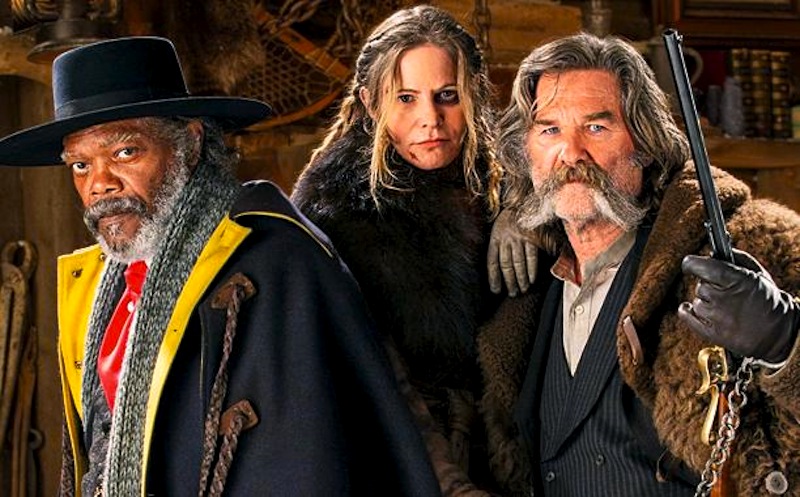
The Hateful Eight (2016), directed by Quentin Tarantino.
Noting the near absence of rating stars above, the reader can be forgiven thinking that this reviewer loathes Quentin Tarantino. Tarantino’s work is certainly controversial, certainly has its vocal critics (perhaps most notably Spike Lee), and seems at times to be created almost deliberately to divide moviegoers and scribes. But know this: I’ve enjoyed tremendously the man’s last three movies, and put Inglorious Basterds and Django Unchained on my top ten lists, the former as my favorite picture of that year. But Hateful Eight is different, Tarantino fans—it’s dull, it’s offensive only for the sake of offense (and even then, barely so), and, perhaps worst of all, it’s a “message” movie.
What this means is that The Hateful Eight is deadly dull. And I can’t believe I would ever have accused him of that.
The Hateful Eight, famously shot in Ultra Panavision 70mm, opens among the great vistas of wintertime Wyoming a few years after the Civil War. A stagecoach drives through the snow: shots establish this not only as God’s country but a canvas on which Tarantino is going to give us arresting visual images. It’s the ideal setting for a strange western—mountains fogged with drifting snow, the ground a blinding white (which should be a perfect contrast for vast sprays of blood), a wooden crucifix covered in ice, and, to make matters even better, the sounds of an original Ennio Morricone score drifting in the background.
We see the wagon being driven at high speed through a mountain pass, its driver’s cries of “hyah!” echoing into the pines. Suddenly, standing in the middle of the road is one Major Marquis Warren (Samuel L. Jackson), a bounty hunter with a stack of bodies behind him. His horse is dead, and can he hitch a ride? OK with the driver, but the passenger has paid for a private ride.
That passenger is “Hangman” John Ruth (Kurt Russell, chewing his lines with a lot of flair), who is escorting one Daisy Domergue (Jennifer Jason Leigh), a murderer, to the town of Red Rock, where she’ll get a quick trial and a hanging. After various arguments, Warren joins them.
Already, Tarantino has belied our expectations. After those wide vistas, and Warren on the road, our gang will be joined by Walton Goggin’s dim Sheriff Mannix, and we’ll find ourselves thrust into the cozy confines of this stagecoach. For the next twenty minutes to a half hour, we’ll have some of the most stilted and didactic dialogue, leading to a host of predictable moments and the start of string of violent abuses to Ms. Domergue, from being told to shut up before being elbowed in the nose, to being punched out of the carriage. All in 70mm.
We learn about “Hangman” Ruth’s propensity for bringing in his quarry alive to hang, about Major Warren’s past Civil War service, about Mannix’s work as a renegade Rebel soldier who destroyed black communities, then about Warren’s burning down a Rebel camp (which killed white people from both sides), to the Major’s “Lincoln Letter”, a personal letter he carries with him from the beloved assassinated president. He will take out this letter to show John Ruth, who will show it to Daisy, who predictably tries to destroy it. In case you were wondering, at no point in this claustrophobic talk-fest does Daisy get to explain what brought her to be abducted, what crimes she committed, where she’s from, etc. But she does say the n-word repeatedly.
Our party is traveling with a terrible blizzard on their heels, and it’s to Tarantino’s credit that he clearly shot this film in miserable conditions. It doesn’t matter if the snow is real or not, it’s obviously cold, as evidenced by the breath steaming from man and horse, the trees stripped of leaves, and the gray, gray skies. But the blizzard forces the story to leave the outdoors, and go… back indoors, to a waystation called Minnie’s Haberdashery, where our five travelers (including the driver, O.B., played by James Parks) will meet four others, which actually makes nine. I guess the driver doesn’t count. There’s another one hiding, but by then others have died, so…
Inside this cramped environment waits a Mexican man named Bob (Demian Bichir), Joe Gage, a quiet cowpoke with horribly dyed black hair (Michael Madsen), Confederate General Sandy Smithers (Bruce Dern), and, worst of all, Red Rock’s hangman, Brit Oswaldo Mowbray. He is played by Tim Roth, who puts in his very best Christoph Waltz impression, from the latter’s voice to his dancelike way of walking, to his way of extending his hands as if he’s introducing a vaudeville act. Roth is a pretty bad actor, but this could be the worst performance I’ve seen this year.
To Major Warren’s surprise, Minnie, of Minnie’s Haberdashery fame, is missing, along with her staff and her husband, who normally is plopped down in his favorite easy chair, playing chess with someone. Where did they go? It soon becomes apparent that someone—or everyone—is out to stop the Hangman from delivering on his promise to see Daisy hang. The mystery begins!
For the next hour, we are going to hear a lot more backstory, watch Daisy get punched around and bloodied (but again, none of her past), and get to listen to a bunch more political theories and ideas—Tarantino wants us to know that despite his wanton use of the n-word, he really is in tune with African Americans, especially in a preachy moment between Major Warren, Mannix, and “Hangman” John, that is more difficult to endure than any of the violence.
The Roadshow version of The Hateful Eight includes an old-school style “overture”—back in the 50s and 60s, big budget “roadshow” movies had about five minutes of a dark screen, with merely the word “overture” on it, with the score playing, which happens here. It includes an intermission of about fifteen minutes. Should you see this version—and I don’t know what the non-Roadshow removes—you’ll have two movies to peruse. The first is a sort of Deathtrap meets Carpenter’s The Thing meets a spaghetti western. Everyone’s trying to figure out what the other is up to, people move around the cabin like it’s a stage, and yet we still don’t quite know the mystery. It closes with a scene of predictable violence—the saddest part of this movie is its utter lack of surprise—and then we get the second half after the fifteen-minute intermission.
Which, for no reason I can understand, opens with narration. And the narrator, a white man whose clipped Manhattan accent made me wonder if he literally wasn’t the same guy who brought us up to snuff in Woody Allen’s You Will Meet A Tall Dark Stranger, is just awful. Out of the Agatha Christie playbook, one character put poison in the coffee, and Tarantino, as he did so clumsily in Jackie Brown, takes us back in time to see this, with the narrator talking with the sly wink of some bad actor from a dinner theater. The poison kills two of our remaining seven, involving blood being vomited in gushes. And here is where The Hateful Eight starts to seem like a sad retread of Evil Dead 2: a head is liquefied by shotgun blast, men shot in the guts, brains gets blown all over another’s face, and one guy gets his balls blown to smithereens.
Two things: part of the backstory is revealed, including the demise of Minnie (Dana Gourrier). We see another stagecoach arrive, this time with many of the characters waiting at Minnie’s. Inside the Haberdashery, we see a racially mixed couple, Minnie and Sweet Dave (Gene Jones) who live a life of almost insanely eupeptic joy. When these roughs walk in, we see Minnie and stagecoach driver Six Horse Judy (Zoe Bell) winking and smiling at one another, happily serving coffee and food, playing chess, grossly idyllic. Earlier, we’d learned that if there’s one thing Minnie hates, it was Mexicans, but that hate seems to have dissipated. Minnie and crew are brutally murdered, in a scene you could see coming for miles, with violence that is not affecting in the least.
Second: Channing Tatum plays a guy named Jody. He tries to put on a tough western accent. “He sounds like Harry Connick, Jr.,” my friend, Mark, noted. And he does, he really does.
The Hateful Eight isn’t just a terrible message picture, it’s bad Tarantino. The characters make no sense and contradict themselves repeatedly—at the start the General wants nothing to do with the Major because the Major’s black, then invites him to sit down, one solider to another. No one changes thanks to lessons learned, but because it’s convenient to the story. The violence is excessive but predictable and dull. And just as Tarantino screwed up by keeping us cooped up in the cabin, the remaining characters in the last half hour are injured to the point of being debilitated—people barely move, grinding the film to a bloody halt. Daisy is a character who meets a horrible fate, but it was never earned—without backstory, we can’t feel for her, but we’re unable to hope that she meets a horrible death. Tarantino seems to think that her spouting racist drivel is enough, but it’s not.
In the past, I’ve appreciated Tarantino’s use of the n-word and his gratuitous violence. At times: in Django Unchained it makes no sense to avoid the n-word, or to temper the brutality. Aside from the critically reviled Mandingo, there has not been a movie that so committed to showing the penetrating evil of slavery, and I include 12 Years a Slave in that statement. Where that movie made its violence seem as controlled as the violence in McQueen’s earlier Hunger, Django, with Mandingo, made the cruelty so shocking and sudden, it turned heads (whereas 12 Years did not.)
Tarantino’s commitment to historical violence made sense to me then, and you can’t have a movie taking place in the 19th century, have white and black characters engaging with one another, and avoid the n-word. But here, Tarantino, as he did in Pulp Fiction, overuses it, wasting its energy. At times he seems to use it as an excuse for “better” men to beat and demean Daisy. (And for a great examination of Tarantino’s obsession with saying the n-word, check out this article.)
Most of all, The Hateful Eight doesn’t work in any way. The close of the film, involving a bugle playing a patriotic sounding tune while the Lincoln Letter is read, works only as a parody of message films, but leaves you wondering why? Long, unexciting, preachy, and without even the saving grace of cynicism, The Hateful Eight sees Quentin Tarantino reaching for meaning, at the expense of his strengths.
This article originally appeared in Joyless Creatures.
 Movies with People Watching Movies