
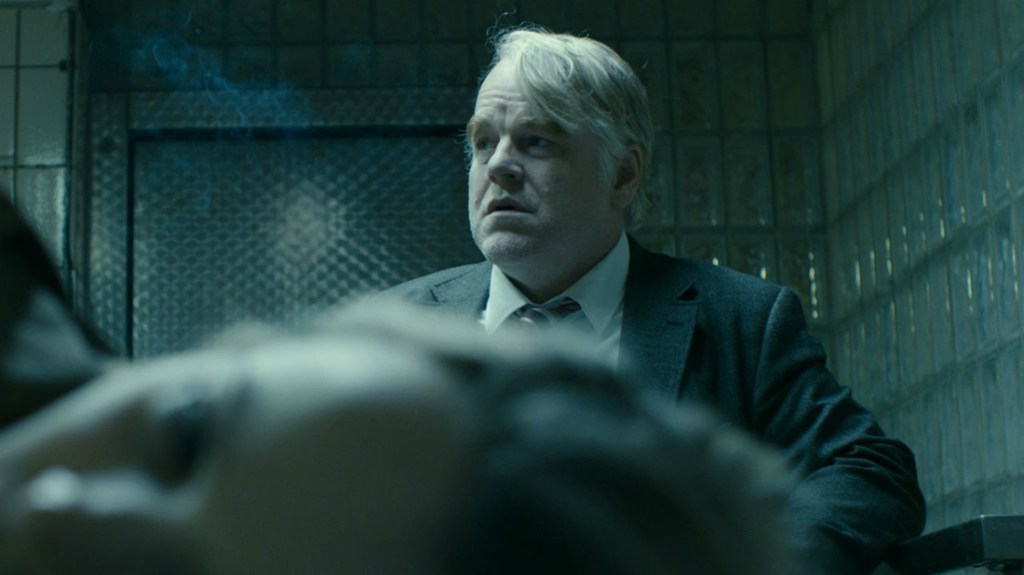
A Most Wanted Man (20140, directed by Anton Corbijn.
In Hamburg on a frosty morning, a man rises from out of the sea, climbs up a ladder, and stumbles onto a filthy dock. He crosses a set of railroad tracks, creeps through dozens of new automobiles, parked in a massive lot en route to German dealerships. Finding one of the cars unlocked, our man climbs inside, cold, probably hungry, obviously exhausted. In no time he is asleep.
Back in the 20th Century, we might have looked upon this man as merely a refugee seeking a new life—perhaps a Soviet dissident pushing past the Iron Curtain, or maybe someone seeking asylum just because conditions are horrible back home in Iran. But this is the 21st Century, and this is Hamburg, which was home to a key terrorist cell that included many participants in the 9/11 attacks. And so this man, with eastern European features and a scraggly beard, who later is seen praying at a mosque, now carries incredible symbolic and political weight. Is he a terrorist? Or is he just a man, seeking, as many immigrants do, safety from oppression?
Unfortunately, these troubling questions are explored poorly in A Most Wanted Man. The film, directed by Anton Corbijn, clearly seeks to capture the thudding daily lives of international spies, the sad and crushing reality of the people caught in the crosshairs of government affairs, and wants to peel away the veneer behind the so-called democracies of the world. But instead it proves that spy movies based on John le Carré’s work can be as predictable and uninspiring as those based on Ian Fleming’s. For A Most Wanted Man is exactly that—more of the same drudgery and deceit that we’ve come to expect from pictures based on his books, without a shred of anything new. A more predictable film I haven’t seen this year.
After the poor soul at the beginning of the movie finally secures a hiding spot with another Muslim family in Hamburg, Corbijn introduces us to the people who are squinting over this human chess board, most notably Gunther Bachmann. As with most le Carré heroes, Gunther is seeking redemption, a disgraced German intelligence officer who once failed miserably, resulting in the death and capture of other human pawns in a prior operation. Gunther is played with utterly despairing panache by Philip Seymour Hoffman, who sports a thick German accent, which he handles nimbly. He’s brilliant—you can almost smell the cheap whiskey, cigarettes, and stale body odor emanating off this wreck of a man.
Turns out the desperate young man at the opening is one Issa Karpov (Grigoriy Dobrygin), the son of a former Chechen general who raped the young man’s Muslim mother. Karpov loathes his deceased father, who has left a great sum of money for his son in a Hamburg bank. Knowing this, Karpov, the victim of torture at the hands of both the Russians and the Chechens, hopes to use his inheritance to help fund Muslim causes.
Everyone wants to find this kid—German intelligence, the Americans, and Gunther, who works for the former but is at odds with them about what to do with Issa. The Germans want to arrest Karpov and bury him in a dark cell forever, which, the movie barely implies, is a result of the embarrassment of the 9/11 terrorist cells—better to overreact than allow another full-scale attack.
But Gunther has other ideas. Living in Hamburg is Dr. Faisal Abdullah (the very dignified Homayoun Ershadi), a scholar who runs an organization that helps the worldwide Muslim community in a variety of ways. Gunther believes Dr. Abdullah is secretly funneling donations into Al-Qaeda. Gunther correctly surmises that Karpov wants to give his money to Dr. Abdullah, and whether or not the kid knows the extent to which that money is going toward terrorism is beside the point— Karpov is a minnow that he can used to catch the really big fish.
All of this is spelled out through tense and frustrated meetings in glass buildings between frustrated spy and asshole boss, with Gunther’s past failures and his very loyal team being put on the defensive. These scenes are interminably long and lack the tension of the almost identically structured Tinker, Tailor, Soldier, Spy, with little of that film’s brilliance. It takes a deft hand to make countless meetings exciting, and that’s exactly what Tomas Alfredson did, and exactly what Anton Corbijn does not pull off. Here they come off as actor’s exercises, each person reading their lines in a vacuum.
Karpov needs a conduit into the bank which holds his money, and he wants asylum in Hamburg, and so the family with whom he is staying manages to connect him with an immigration lawyer. Enter Annabel Richter, played by Rachel McAdams. There is absolutely no reason whatsoever to cast McAdams here, who struggles like a drowning cat in this wretched sea of German accents—she is the worst of a good, though strained, bunch (only Hoffman is really capable of carrying this off, and even he flails a bit). Richter tries to help Karpov get his father’s money from corrupt banker Tommy Brue (Willem Dafoe, whose accent also makes it sound like he’s an extra from Hogan’s Heroes).
Gunther’s people follow all of this from afar, using every means of surveillance at their disposal. Given a mere 72 hours to deliver Dr. Abdullah, Gunther makes his move, with the assistance of the cold, calculating CIA agent Martha Sullivan (Robin Wright), who, we should all know (Gunther, too), will totally betray him. Because that’s really the only direction this film is going.
Aside from the utter predictability of this plot—here, le Carré or screenwriter Andrew Bovell seem incapable of creating a situation that is surprising or even, at times, interesting—the acting is wildly inconsistent. McAdams, to be blunt, is horrible. Even setting aside her failed accent, she cannot do anything with this character and has to bug her eyes out and appear stunned at the many ways in which Karpov is screwed over (one would think an immigration lawyer and human rights activist would be the slightest bit jaded, or at least fairly realistic, about the fate of her client, even in Germany).
Worse, the fellow spies in A Most Wanted Man could very well wear t-shirts that say “SPY!” and the ones who are bad sneer and squint, the good ones (on Gunther’s team) smile and drink and wear clothes that come in a variety of colors. Certain subplots make no sense, like the fact that one of the spies for Germany is one character’s adult son, and we’re given no reason why he would betray his own father.
In the end, the only reason to endure A Most Wanted Man is a melancholy one—to see the last magnificent performance of Philip Seymour Hoffman. If you look at Hoffman’s career, you will see a variety of poor to mediocre films, but in each (including Patch Adams!) he delivers a performance that just takes your breath away. Despite the plodding nature of A Most Wanted Man, I have to say that I would recommend it just to watch Hoffman, who is at times almost literally breathtaking, such as a scene in a bar where he punches out a fellow patron. Corbijn was lucky, then—he didn’t do the world any favors with this near-trainwreck, but he managed to give us one last glimpse of Hoffman’s sublimity.
 Movies with People Watching Movies