
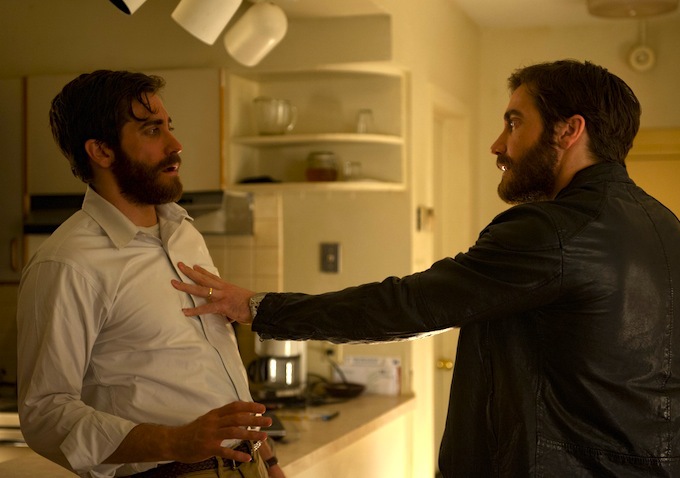
Enemy (2014), directed by Denis Villeneuve.
Chaos is order yet undeciphered.
That quote, from José Saramago’s source novel The Double, might have been a clue that led readers to scour his complex book, searching for clues. For viewers of Denis Villeneuve’s shallow Enemy, which offers that tidbit to viewers toward the beginning of the film, it serves as a way of telling (as opposed to showing) the audience that there’s more than meets the eye…even if there’s a lot less than meets the eye in this one.
Much has been made about Enemy’s spider fixation, and its “horrific” ending, which has been acclaimed as the scariest in the history of movies—a startling overstatement and only something an arachnophobe would seriously consider making. But what makes Enemy so underwhelming is that it actually takes what might have been a fascinating story and turns it into… what? An examination of the sexually obsessed? A critique of totalitarianism? In the end, the predominant question we ask ourselves is: do I care?
Enemy begins with a shot of the Toronto skyline, shot through with drab, sulphurous yellow, while Isabella Rossellini’s voice inquires as to the mental health of her son, Adam Bell (Jake Gyllenhaal.) “I’m worried about you,” she intones, and then Enemy takes a dark turn into the depths of what appears to be a sex dungeon—groups of morose older men, and an anguished man who might be Bell (but might be his double), stare at glistening nude women, one of whom lifts an ornate silver cloche that reveals a spider, which one crushes under a high heel.
From there we find that Adam Bell is a professor, of history it seems, a slumping, melancholy man dressed in tweed, who makes his way back and forth between the Brutalist warrens of his university and his massive apartment complex. He doesn’t seem to live for anything—he repeats his lectures with little emotion (to near empty classrooms), droning about how totalitarian societies control their citizens in various ways. At home, he grades papers, ignoring his attractive girlfriend so that he can watch a silly movie that was recommended to him, with barely any excitement, by a colleague.
But the movie in question (which was rented at a video store—with the cheap cell phones, older cars and the video store, one has to wonder why Villenueve chose to locate this in the late 90s or early 2000s) reveals a secret: one of its bit players looks exactly like Professor Bell. Seized by a need to discover more about his “double”, our hero begins to investigate.
Enemy is one of the movies where every character reacts in a narrow manner that only serves to augment the film’s ostensible point. Calling his double on the phone, Bell reaches the man’s wife instead—and she is instantly shocked, horrified, as is pretty much everyone in the movie, at all times. Outside of an inexplicable scene where Bell is elated about his double’s meeting him, no one seems to have the very human curiosity about this strange occurrence—it’s just a harrowing, confusing, terrifying situation.
We learn that Bell’s double, Anthony St. Claire, is an actor who has but three non-speaking parts in films…but in this society has parlayed that into a gorgeous apartment. (Enemy is nothing if not a glorious opportunity to nit-pick at its many inanities in almost every one of its 90 minutes.) Anthony, it seems, has been having affairs—affairs that his wife, Helen (Sarah Gadon), is privy to. She wonders if the voice on the phone is an angry man whose wife Anthony’s been screwing, and confronts Anthony, but does almost nothing else. Of course, moments earlier she was freaked that the man sounded exactly like her husband, but then forgets that to suggest it’s a cuckholded spouse. Helen is six months pregnant, and herself dour, unhappy, and incapable of even expressing what she wants from anyone.
The two men meet, in a dingy hotel that has gorgeous prostitutes in sexy lingerie swinging keys around out in the open, apparently so that we understand that something sordid is going on. The scene is short, underlit (of course you wouldn’t turn on the light in a room where you’re meeting your exact duplicate, right?), and not uncomfortable—like most of the scenes in Enemy, tension is strangely absent. Much of this is due to Gyllenhaal’s drab performance, one in which he relies almost totally on his clothes and his posture to communicate which character we’re watching. (Comparisons between this and Dead Ringers or this Twilight Zone fail fairly miserably—that’s Joe Mantell, who told Jake “Forget it, it’s Chinatown.”)
And here begins the moment when the main characters leap back and forth in terms of their interest in this…project. First Adam is freaked out when Anthony asks to see his hands and then Anthony wonders if they share a scar on their chests. (They do.) From there, Villeneuve and co-writer Javier Gullón take a hard right turn, and Anthony, himself now following the professor, sees his double’s girlfriend and is excited. Accusing Adam of sleeping with his Helen, Anthony rages, and demands compensation. All Adam can do is stutter, and then inexplicably concedes to Anthony’s demand…to take the professor’s clothes and haul his girlfriend away to that awful hotel, for a “romantic getaway.”
Of course, Adam makes it a point to shack up with Anthony’s wife, who seems pleased at the switch, and then the film comes to its inevitable conclusion, including a crazy final scene involving a spider.
But what is to be made of Enemy? First, who is the “enemy?” Is it Adam’s doppelgänger? To go by the movie, you could argue that it’s the shrewish women that our heroes encounter—Rossellini’s mother seems to exist only to chide Adam, Helen is both angelic and a bitch, while Mary, Adam’s girlfriend (played by Inglourious Basterds Mélanie Laurent, who is totally wasted here), is a sex object and shrill bore—none of these women have a single edifying scene, but then again I guess that goes for everyone.
There’s plenty of spider symbolism lathered onto Enemy, which seems to want to be a movie about totalitarianism or personal dictatorship—consider this quote from the director about the film: “Sometimes you have compulsions that you can’t control coming from the subconscious… they are the dictator inside ourselves.”
But that begs the larger question, namely, what does that mean in the context of the movie? It doesn’t mean a lot outside the film—yes, many of us have obsessions, compulsions, and addictions. Here, Adam/Anthony aren’t examined enough for us to really plumb those supposedly sordid depths. Adam/Anthony is little more than a cipher, one a sad sack who can barely get through his day, the other a sex obsessed failure whose life actually doesn’t appear as having been ruined by this desire (or his inability to work.) Who are these men?
Should you desire to go down the spider-hole and take Enemy as a parable of a totalitarian society, perhaps a society where we are trapped, then do so for Christ’s sake. Compare this to the superior The Lives of Others, where East Germany’s oppressive government was literally listening in to your every move, even your lovemaking. Enemy is totalitarianism as an indie movie trope, rather than an indictment of totalitarianism in the world–1984, The Lives of Others…these spoke to worlds that were expanding or had existed in the recent past, filled with damning little details of how this type of world destroys souls. Does Villeneuve believe that his home country, Canada, is veering (or has veered) into totalitarianism? Does he understand addiction or obsession? Is this why Villeneuve sticks his movie in the near-past? It would be more work to examine this society with all the streaming and iPads and the smartphones.
Details are absent here because Enemy isn’t actually about anything but the most abstract political and psychological theories. This is a half-baked exercise in indie filmmaking—grabbing a (probably great) novel, which I’m sure contains multitudes, stripping down its plot while layering it with unsubtle symbolism, an oppressive, Hans Zimmer-like score and nifty cinematography that in itself doesn’t add much to the movie. Saramago grew up under Portugese dictatorship, and of course right next door to Franco’s fascist Spain–The Double is probably not only an intellectual tour-de-force, but a personal work that spoke to the author’s experience. And so Villeneuve, who admittedly conceived of this movie while getting drunk with Gyllenhaal, took what was probably a very personal work of art, and turned it into an empty puzzle.
This article originally appeared in Joyless Creatures.
 Movies with People Watching Movies