
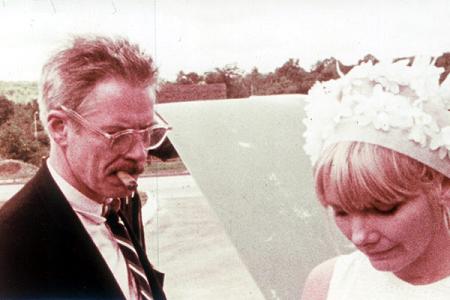
“One and Done”. What does that mean? It’s actually kind of depressing: five great movies from directors who never made another movie again. At least, they never directed another movie again.
What causes this? All the films here are really great, or they’re tremendously cool, and just miss great. Night of the Hunter is the nonpareil, of course–whenever a critic mentions a director who never made another movie again, pretty much they’re talking about Hunter. My theory is that Laughton was so devastated by the intense critical backlash to his movie that he just didn’t think it worthwhile to try again.
I’m guessing that Barbara Loden, who made the brilliant Wanda (and who was known at the time as Mrs. Elia Kazan), couldn’t finance another movie, both because Wanda was such a small success (if it was a success, financially, I mean), and Hollywood didn’t give a rat’s handshake about female directors, then as now (though it’s certainly gotten better.) Plus, she died fairly young, at age 48, from breast cancer. Loden was known as an actress, a model (she’s featured on a 2002 Garry Winogrand postage stamp!), and not, unfortunately, as a director–though after seeing the devastating Wanda, you wonder why that wasn’t the case. But Wanda, the story of a woman who is so adrift in this life you wonder if she’s not made of paper, is heart-wrenching. How I wish she’d made another movie. One of the best of the 1970s.
Electra Glide in Blue is something else altogether. Great? Probably not, but cool as hell, and fun to boot. It also is fairly radical for its time. Robert Blake is a motorcycle cop who is intelligent and sensitive–he takes his job seriously and believes himself to be only on the side of law and order. What this means, to him, is that he needs to work without prejudice to solve crimes and foster justice on an injust world–it does not mean harrassing hippies, nor does it mean towing the line with his fellow men in blue. In fact, this sense of justice is his ultimate doom. The surprise ending is perfect.
Director James William Guercio was a producer of the band Chicago’s first albums, and the band makes an unintrusive cameo appearance. I get the feeling this is a case of a vanity project turned into something of quality, that Guercio was hopping on the Easy Rider bandwagon, but somehow, inexplicably, made a very good movie (so unlike Rider, and thank God for that.) However, its negative reception and poor box-office probably kept Mr. Guercio–a producer with his eye on the bottom line–out of the field forever.
OK, now for the weird one, the one I simply cannot explain: Leonard Kastle’s The Honeymoon Killers. I’ll never forget first watching this baby on DVD with my wife. We were mesmerized–this is seriously an arresting film in the purest definition of that term. We did not pause the movie once, watched it from start to finish in rapt silence. Is the acting great? Not really, but it’s fascinating, and the chemistry between the two actors–Tony Lo Bianco and Shirley Stoler–is so intense you should be afraid to light a match, lest you blow up your living room. Both suspenseful and melancholy, and with a magnificent final shot (its black and white cinematography is amazing), Honeymoon Killers is a masterpiece in my book.
“Leonard Kastle?,” you ask. Wasn’t he that guy who smoked big cigars and had those buzzing seats? Eventually produced Rosemary’s Baby? No, that’s William Castle, shlockmeister extraordinaire. An understandable mistake… except that Castle with a ‘C’ would have made Killers a horrible sub-‘b’ flick. No, Leonard Kastle was an opera composer (you read that right), who was fascinated by the real-life crime spree of Raymond Hernandez and Martha Beck, the couple who placed want ads in the lonelyhearts section of the papers, and murdered the spinsters who responded to them. Apparently, Martin Scorsese was originally hired to direct (back before he was famous and would work for next to nothing), but he was let go for moving at a snail’s pace. Kastle was a friend of the producer, and he did meticulous research on the screenplay, so they figured, why not let him direct? He did, and the result is a doozy. When it was all over, Kastle went back to teaching music and writing opera. There you have it.
Last but not least is a beautiful western, the underheralded Three Burials of Melquiades Estrada, Tommy Lee Jones’ only foray into directing. Simply put, this is a great, great film, and what makes it great is its examination of friendship, its honesty, and its simple love of people. Jones doesn’t beat you over the head about his opinions on immigration and border politics–it’s there, under the surface. Three Burials celebrates actors, and it is directed with a steady, patient hand, avoiding the tendency of actors turned directors to make every shot stand out (yes, I’m talking about you, George Clooney.) This could be the most optimistic movie on the list, since Jones may in fact make another movie again. Three Burials’ modest box office, Jones’ age, and the fact that he’s a busy man, may however make this his sole effort. But it’s one for which Jones should be damn proud. (NOTE: Jones has directed a pretty bad movie since this was written.)
 Movies with People Watching Movies